VAPT for Manufacturing
Security testing for the systems that keep production moving. Modern manufacturing environments connect enterprise IT, production systems, industrial networks, remote access, connected equipment and business applications — creating a security challenge where performance, reliability and safety requirements demand controlled testing boundaries rather than indiscriminate scanning.
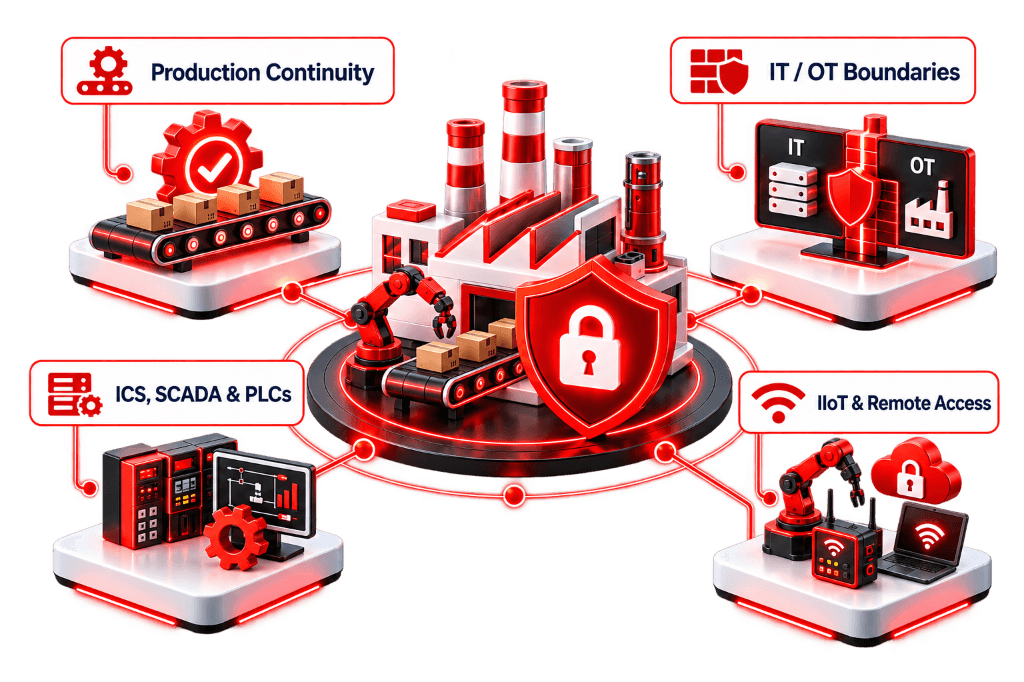
Scope It. Test It. Validate It. Fix It.
Ready to scope a manufacturing VAPT engagement? Talk to our industrial security team.
Security Testing for the Systems That Keep Production Moving
Modern manufacturing environments connect enterprise IT, production systems, industrial networks, remote access, connected equipment and business applications.
That creates a security challenge that ordinary IT testing does not always address well.
OT environments have different performance, reliability and safety requirements, so security testing needs to consider what is connected, what is critical, what can safely be tested and how an identified weakness could affect the production environment. NIST's OT guidance specifically calls out these unique requirements.
NuageSEC identifies Manufacturing as an industry it serves, with public capabilities covering production systems, OT environments, industrial networks and connected manufacturing infrastructure.
The Plant Floor Has Different Consequences for Security Decisions
A conventional IT environment prioritizes confidentiality and access control, while manufacturing environments must balance them with operational physics:
NIST SP 800-82 Rev. 3 specifically explains that OT security needs to address performance, reliability and safety requirements because OT systems interact with or control physical processes. Its scope includes ICS, PLCs, DCS and SCADA environments. The question is not: 'Can we scan everything?' It is: 'What can we safely test, and what could a weakness actually affect?'
IT and OT Are No Longer Completely Separate
Connectivity creates productivity — and new security boundaries. Manufacturers increasingly connect OT environments with enterprise IT systems to improve operational visibility, remote maintenance, predictive analytics and business planning.
NIST notes that this IT/OT convergence improves manufacturing agility while simultaneously increasing exposure to external cybersecurity threats.
The security concern is not that IT and OT should always be completely disconnected. It is whether the connections that do exist are appropriately controlled, authenticated and understood.
The Real Manufacturing Security Question: Where Can a Weakness Travel?
A vulnerability becomes vastly more dangerous when it provides a bridge from an untrusted network into a sensitive production zone. For example: an external internet-facing system → corporate network → remote-access pathway → OT-facing environment → industrial control system.
NIST's manufacturing security framework specifically recommends asset grouping and security segmentation based on communication requirements, mission criticality and operational sensitivity.
A Manufacturing VAPT Helps Establish
Production Continuity Changes How Testing Should Be Done
More testing is not automatically better testing. A manufacturing environment may contain systems that are difficult to patch, sensitive to high-volume network traffic, or impossible to reboot outside of major plant turnarounds.
NIST's OT guidance explicitly recognizes the reliability and safety constraints that distinguish OT environments from conventional IT systems.
Crucial Scoping Elements Defined Before Any Assessment
For sensitive OT assets, the testing approach should be selected around the operational environment rather than blindly applying an aggressive IT vulnerability scanning methodology.
Not Every OT Asset Should Be Actively Exploited
A manufacturing VAPT should distinguish between assessment and exploitation. This is one of the most critical differences between manufacturing and conventional application security.
For some assets, active exploitation may be appropriate within controlled test environments. For others, safe assessment approaches are required to evaluate configurations, firmware and access controls without sending hostile payloads to sensitive control hardware.
Tailored Industrial Assessment Approaches
A disciplined methodology combines multiple non-disruptive techniques:
NIST's OT guidance emphasizes tailoring cybersecurity controls to OT's performance, reliability and safety requirements. A manufacturing VAPT should never be marketed as 'scan every PLC and exploit every vulnerability' — that would be a catastrophic fit for real production environments.
IT-OT Segmentation Is a Security Boundary
Understand which systems are allowed to communicate — and why. Segmentation is not simply about placing a firewall between two networks.
The important question is: Which communication paths are actually required for production, and which are unnecessary or excessive? NIST's manufacturing guidance describes security segmentation as grouping assets according to communication and security requirements, with security zones and conduits used to protect assets according to operational criticality.
A VAPT assessment validates relevant exposure and boundary controls within the authorized scope (Corporate IT ↕ Controlled Boundary ↕ Manufacturing / OT) to confirm that unintended access paths cannot be traversed.
See how NuageSEC tests internal and external network segmentation boundaries. Explore Network VAPT Services →
Remote Access Can Change the Plant's Attack Surface
Remote connectivity can be operationally necessary — and security-sensitive. Manufacturing environments frequently require remote access for plant maintenance, OEM vendor diagnostics, engineering modifications, monitoring and emergency support.
That creates an important security boundary. The objective is not to eliminate remote access, but to verify whether remote connectivity provides more access than the business intended.
Remote Access Assessment Questions
Where authorized, testing validates whether an authenticated remote vendor session can pivot into unauthorized plant segments or control assets.
Legacy Systems Create a Different Security Problem
A vulnerable system may not be easy to replace. Manufacturing plants contain long-lived technology with multi-decade operational lifecycles and tight physical dependencies.
NIST's manufacturing work identifies the need to protect assets according to their operational function and mission criticality, rather than applying identical controls to every asset. For legacy environments, security teams face a difficult question: How do we reduce exposure when patching or replacing the underlying system is not immediately practical?
A Useful VAPT Engagement Identifies
Manufacturing Also Has an IIoT and Connected-System Problem
More connected equipment means more systems to understand. Smart manufacturing introduces connected sensors, industrial edge gateways, IIoT telemetry platforms, smart meters, predictive maintenance devices and cloud analytics services.
NIST notes that manufacturers are connecting network-based smart IIoT devices to collect and transmit manufacturing information, increasing the importance of cybersecurity around those environments.
Connected Industrial Systems Requiring Security Validation
The security question becomes: Which connected assets are exposed? What do they communicate with? What credentials or trust relationships exist? Could a compromised connected system reach another environment?
Third-Party Access Can Become Part of the Attack Surface
The plant may depend on vendors you do not directly operate. Manufacturing organizations rely on external providers for equipment maintenance, industrial automation software, remote PLC support, cloud SCADA services, engineering updates and managed infrastructure.
A third-party connection creates a security pathway: Vendor → Remote Access → Manufacturing Environment. The practical security question is: Does the access available to a third party match what that third party actually needs?
Where testing is authorized, VAPT helps validate relevant externally accessible interfaces, jump hosts, and communication boundaries.
Intellectual Property Is Another Manufacturing Asset
Production security is not only about stopping downtime. Manufacturers depend heavily on proprietary information such as engineering drawings, CAD files, product formulations, manufacturing process recipes, operational documentation and commercial pricing.
A security assessment must consider both operational control systems (preventing physical disruption) and enterprise information systems (preventing data theft and industrial espionage).
NIST's manufacturing cybersecurity guidance recognizes risks to manufacturing systems and associated sensitive information, while ISA/IEC 62443 addresses confidentiality, economic loss, safety and environmental consequences.
VAPT Should Not Be a Scanner Report with a New Cover Page
Manufacturing teams need evidence they can act on. A meaningful assessment distinguishes between a potential vulnerability and a validated security weakness.
NuageSEC's VAPT approach describes combining automated vulnerability identification with expert manual penetration testing to validate real-world exploitability and prioritize remediation based on business and operational risk.
For manufacturing, that distinction matters because a long list of scanner findings does not tell operations which weakness matters most, which asset is affected, whether it can actually be exploited, or what should be fixed first.
What a Manufacturing VAPT Report Should Show
A Manufacturing VAPT Scope Built Around the Environment
| Your situation | Recommended starting point |
|---|---|
| Corporate IT | What systems and services could provide an entry point? |
| Internet-facing applications | Can external attackers exploit application weaknesses? |
| ERP / business systems | Can unauthorized users access sensitive business functionality? |
| Remote access | Who can connect and where can that access lead? |
| IT/OT boundary | Are unintended communication paths available? |
| Industrial network | Are exposed services and access paths appropriately controlled? |
| OT environment | Which assets can be safely assessed and how? |
| IIoT / connected systems | What devices communicate with other environments? |
| Cloud / connected services | What supporting systems form part of the attack surface? |
| Third-party connectivity | Does vendor access remain within its intended boundary? |
NuageSEC's manufacturing positioning specifically addresses ERP infrastructure, remote connectivity systems, corporate networks, production systems, OT environments, and connected manufacturing infrastructure.
Where VAPT Fits in the Manufacturing Security Program
VAPT is one part of a broader security lifecycle. It provides empirical evidence about technical weaknesses and exploitable attack paths.
It does not replace foundational security disciplines: asset inventory, network segmentation, patch management, identity management, backups, incident response, disaster recovery, vendor risk management and secure engineering.
NIST's manufacturing guidance similarly treats security as an ongoing risk-management and architectural process. The role of VAPT is to answer: 'Where could our existing controls fail under authorized testing, and what needs to change?'
When Should a Manufacturer Consider VAPT?
| Your situation | Recommended starting point |
|---|---|
| New plant technology | Validate new assets, interfaces and connectivity exposure |
| IT/OT integration | Verify that new trust boundaries and IDMZs are secure |
| New remote-access solution | Test authentication, jump hosts and lateral movement paths |
| Major network re-architecture | Audit segmentation rules, VLANs and firewall policies |
| New IIoT / connected devices | Assess edge gateway exposure and trust relationships |
| Plant modernization / turnaround | Re-evaluate updated architectures and control assumptions |
| Major application upgrade (MES/ERP) | Identify newly introduced application or business-logic risks |
| New vendor or OEM connection | Ensure third-party access remains tightly compartmentalized |
| Post-incident validation | Validate remediation and verify that attack paths are closed |
| Significant security remediation | Retest to confirm that vulnerabilities have been fixed |
| Periodic validation | Reassess an evolving production and enterprise environment |
Important operational distinction: During an active security incident, incident response and containment take priority. VAPT is appropriately conducted post-incident to validate root-cause closure and security posture improvement.
Manufacturing VAPT Should Be Mapped to Risk, Not Just Technology
Two systems can share the exact same technical vulnerability and carry completely different business consequences. System A might be an isolated business application. System B might be an engineering server controlling continuous batch processing.
Manufacturing security teams need findings evaluated across asset criticality, network connectivity, exposure, practical exploitability, access gained, operational dependencies and potential plant impact.
NIST's manufacturing segmentation guidance explicitly considers mission criticality, operational function and data sensitivity when determining protective measures.
Standards and Security Guidance
The framework should match the industrial operational environment:
Important: These references provide security guidance and frameworks. VAPT provides valuable technical assessment evidence, but does not independently establish certified compliance with every standard.
What Manufacturing Teams Should Expect Before Testing
What Manufacturing Buyers Should Look for in a VAPT Provider
Evaluate providers on operational maturity rather than vulnerability volume:
What Manufacturing VAPT Is Not
A useful security engagement sets clear boundaries:
See how NuageSEC approaches cybersecurity across production systems, OT environments, and industrial networks. Explore Manufacturing Cybersecurity Services →
See how NuageSEC approaches VAPT for organizations operating in India. Explore VAPT Testing in India →
Review examples of NuageSEC's reporting approach. View Sample VAPT Reports →
Frequently Asked Questions
What is VAPT for manufacturing?
VAPT for manufacturing is an authorized security assessment designed around the technology environment of a manufacturing organization. Depending on the approved scope, it can include corporate IT, applications, APIs, networks, remote access, cloud environments, connected manufacturing systems and relevant OT environments.
Why is OT VAPT different from normal IT penetration testing?
OT environments have different performance, reliability and safety requirements. NIST SP 800-82 specifically recommends considering these characteristics when securing OT systems.
Can VAPT be performed on PLCs and SCADA systems?
It can be considered only where the assets are explicitly authorized and the testing approach is appropriate for the operational environment. Not every OT asset should automatically undergo active exploitation.
Does manufacturing VAPT include IT and OT?
It can. The scope should be based on the organization's architecture, business objectives, authorized assets and operational constraints.
Can VAPT test the IT/OT boundary?
Where the relevant assets and communication paths are within scope and authorized, testing can assess whether security controls and access boundaries are working as intended.
Can remote vendor access be included?
Where authorized, relevant remote-access systems and pathways can be assessed. The scope should establish which vendor connections are included and what testing restrictions apply.
Will VAPT disrupt production?
Testing can be planned around operational constraints, maintenance windows, exclusions and rules of engagement. The possibility and level of disruption depend on the systems being tested and the testing methods authorized.
Does a vulnerability scan provide the same result as VAPT?
No. A vulnerability scan identifies potential weaknesses through automated techniques. VAPT combines vulnerability identification with penetration testing and manual validation to establish exploitability and impact within the agreed scope.
How often should manufacturing companies perform VAPT?
There is no universal schedule for every manufacturing environment. Frequency should consider changes in architecture, risk, critical systems, remote connectivity, regulatory/customer requirements and previous findings.
Should VAPT be performed during an active cyber incident?
Routine VAPT should not be treated as a substitute for incident response and containment. After an incident is contained and investigated, security testing may help validate relevant weaknesses and remediation.
Does VAPT guarantee production systems are secure?
No. A VAPT assessment provides evidence based on the defined scope, access, testing conditions and methods. It cannot guarantee that undiscovered or future vulnerabilities do not exist.
Does VAPT automatically provide IEC 62443 or NIST compliance?
No. NIST and ISA/IEC 62443 provide security guidance and standards for relevant environments. A VAPT engagement can provide technical security evidence, but compliance or conformity requires the applicable assessment process and controls.
What should a manufacturing VAPT report include?
It should clearly document scope, affected assets, validated findings, evidence, exploitability, relevant business or operational context, remediation guidance and retesting results where retesting is included.
Related Topics
Start Your VAPT Assessment
Tell us about your organization. Our VAPT team will get back within one business day to define the right scope and next steps.
