VAPT for E-commerce
Protect the digital storefront customers trust. An e-commerce platform connects customer accounts, product catalogues, carts, checkout, orders, payment services, APIs, third-party integrations and supporting infrastructure — so a security weakness can affect customer access, transactions, business operations or the trust customers place in the store.
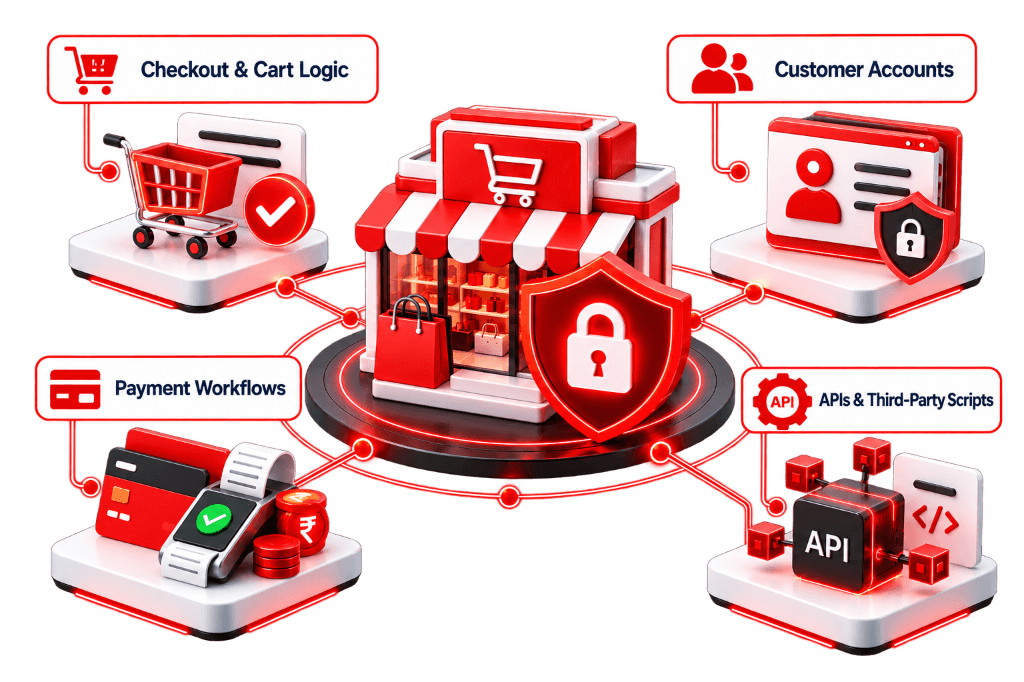
Scope It. Test It. Validate It. Fix It.
Ready to scope an e-commerce VAPT engagement? Talk to our VAPT team.
Protect the Digital Storefront Customers Trust
An e-commerce platform is more than a website.
It connects customer accounts, product catalogues, carts, checkout, orders, payment services, APIs, third-party integrations and supporting infrastructure.
A security weakness in one part of that flow can affect more than the technology itself. It can affect customer access, transactions, business operations or the trust customers place in the store.
NuageSEC provides VAPT and penetration testing across web applications, APIs, cloud, networks and infrastructure, with publicly documented e-commerce assessments.
Your Storefront Is Public. Your Security Boundaries Cannot Be.
An e-commerce environment can expose multiple connected surfaces:
This creates an attack surface where a weakness in one function can potentially affect another. OWASP's current Top 10:2025 places Broken Access Control, Security Misconfiguration, Software Supply Chain Failures, Cryptographic Failures, Injection and Insecure Design among the most critical web-application risks.
The Customer Account Is a Security Boundary
A customer should only be able to access their own account, orders and information. E-commerce applications commonly contain customer-specific objects such as accounts, addresses, orders, invoices, wish lists, saved payment methods and support records.
The security question is not simply: Can the customer log in? It is: Can the customer access only the information and functions that belong to them?
OWASP's API Security guidance describes Broken Object Level Authorization (BOLA) as a major risk where attackers manipulate object identifiers or requests to access another user's objects. OWASP's own example includes an e-commerce platform where one shop's data could be accessed through an API by manipulating the relevant identifier.
This is particularly relevant when an e-commerce application exposes customer or merchant data through APIs.
Customer-Specific Objects Requiring Enforced Authorization
Authorization testing validates whether manipulating record IDs, parameter values or session cookies allows unauthorized access to another user's data.
Checkout Security Is More Than Payment Processing
The transaction can be exposed before the payment is completed. A typical purchase journey contains multiple sequential stages, each relying on distinct business and security assumptions.
Each stage can contain security assumptions. NuageSEC's current web-application security testing explicitly includes payment validation, discount abuse, coupon manipulation, transaction logic, access workflows and multi-step business processes within business-logic testing.
Checkout Security Testing Evaluates Whether Users Can
Business Logic Is Where E-commerce Security Gets Real
The application may work exactly as designed — and still allow unintended outcomes. Automated scanners can find many technical weaknesses, but they cannot evaluate business intent.
E-Commerce Business Rules Requiring Manual Evaluation
NuageSEC identifies business-logic testing as an area requiring manual evaluation and includes payment workflows, discount abuse, coupon manipulation, transaction logic, approval processes and multi-step workflows among its stated assessment areas. For e-commerce, this is one of the most important differences between 'the site has vulnerabilities' and 'the site can be abused in a way that affects how the business operates.'
API Security Sits Behind the Store
The webpage may hide the most important attack surface. Modern commerce platforms often rely on APIs for product data, customer accounts, order management, inventory, checkout, promotions, payments, mobile applications and third-party integrations.
OWASP's API Security Top 10 includes risks such as Broken Object Level Authorization, Broken Function Level Authorization, Unrestricted Resource Consumption and Unrestricted Access to Sensitive Business Flows.
An E-commerce API Assessment Evaluates
See how NuageSEC provides dedicated API testing across authentication, authorization, business logic, data protection, configuration and integrations. Explore API Security Testing →
Payment Page Security Has Moved into the Browser
Outsourcing payment processing does not remove every payment-page security concern. Modern e-commerce payment flows can involve hosted payment pages, embedded payment forms, third-party scripts, 3-D Secure, payment processors, analytics and marketing scripts. That means the browser itself can become part of the security boundary.
PCI SSC's current e-commerce guidance highlights e-skimming risks and PCI DSS v4.x Requirements 6.4.3 and 11.6.1, which address payment-page script authorization/integrity and detection of unauthorized changes to payment pages and relevant HTTP headers.
PCI SSC also clarified in its SAQ A guidance that the relevant script-attack eligibility criterion applies to specific e-commerce implementations involving embedded third-party payment pages/forms.
Important distinction: PCI DSS requirements are not the same thing as a VAPT scope. A VAPT can provide technical security evidence within its defined scope, but it should not be presented as automatically establishing PCI DSS compliance.
Third-Party Scripts and Integrations Need Attention
Every external connection introduces another dependency. An e-commerce platform may depend on external services for payments, analytics, advertising, customer support, fraud detection, shipping, tax calculation, marketing automation, search and reviews. These services can affect the customer journey and, depending on the implementation, can interact with sensitive pages or business processes.
External Services That Influence the Customer Journey
PCI SSC specifically notes the growing complexity of e-commerce payment pages and the security implications of external scripts running in consumers' browsers. For security teams, the practical question becomes: Which third-party components can influence a sensitive customer journey, and what security boundary exists between them and the e-commerce platform?
Platform Security Is Not the Same as VAPT
A secure hosting platform does not automatically make the application secure. E-commerce businesses may use platforms such as Magento, WooCommerce, Shopify, custom-built platforms, headless commerce architectures or commerce SaaS platforms.
The underlying platform can provide security capabilities. But the e-commerce business may still introduce risk through custom code, plugins, themes, extensions, APIs, integrations, configuration, business workflows and third-party scripts.
Therefore: Platform security and application security are related, but they are not interchangeable.
NuageSEC's current web-application service explicitly includes integrations, business logic, configuration, APIs, authentication and authorization as assessment areas.
The Admin Panel Can Be as Important as the Storefront
Attackers do not have to start with the customer journey. The administrative environment may control products, prices, orders, customers, discounts, content, inventory, refund-related functions and user permissions. The exact capabilities depend on the platform.
A weakness in administrative authorization can therefore create consequences that are very different from a low-impact storefront issue. OWASP's API guidance identifies Broken Function Level Authorization as a risk where regular or lower-privileged users can access functions intended for more privileged users.
This makes privileged functionality an important part of e-commerce security testing where it falls within the authorized scope.
Administrative Capabilities Requiring Rigorous Authorization Validation
E-commerce Security Changes with the Business
A store can change faster than its security assumptions. E-commerce teams regularly make changes around new products, promotional campaigns, checkout updates, new payment methods, mobile experiences, third-party integrations, platform upgrades, new customer functionality and backend changes.
A major feature can introduce a new workflow. A new integration can introduce another trust boundary. A checkout change can alter how payment information reaches the browser. A plugin can introduce new code into the storefront. That makes meaningful application changes an important trigger for security reassessment.
NuageSEC's current web-application guidance recommends testing after significant changes such as new feature releases, architecture updates, cloud migrations and third-party integrations.
Operational Triggers for E-Commerce Security Reassessment
E-commerce VAPT Should Go Beyond Automated Scans
A scanner can identify an issue. A tester needs to understand what it means.
E-commerce Security Teams Often Need Answers Such As
What a Useful E-commerce VAPT Report Should Contain
A Real E-commerce Assessment from NuageSEC
Security testing should produce evidence, not generic assumptions. NuageSEC publicly documents an E-Commerce Security Assessment for a company headquartered in Vancouver, Canada, with the engagement performed as a Web Application Penetration Test.
The published findings included SQL Injection risks, Cross-Site Scripting, weak authentication and broken access control. The case study states that these weaknesses created potential entry points that could be exploited against the platform.
NuageSEC also publicly documents a separate web-application penetration test for an e-commerce company headquartered in New Zealand, where the assessed application handled authentication, application workflows and sensitive business data.
These published examples provide actual e-commerce assessment context without assuming that every online store has the same vulnerabilities.
Review NuageSEC's published Vancouver e-commerce security assessment case study. View E-commerce Case Study →
What E-commerce Teams Should Define Before Testing
When Should an E-Commerce Business Reassess?
| Your situation | Recommended starting point |
|---|---|
| New e-commerce application | Customer-facing attack surface & access controls |
| Major checkout change | Newly introduced workflow or payment weaknesses |
| New payment method | Payment integration & script integrity boundaries |
| New third-party integration | Trust relationships & exposed functionality |
| New plugin or extension | Added code, dependencies & attack vectors |
| Major platform upgrade | Customization & security configuration controls |
| New customer/account functionality | Authentication, session & authorization controls |
| Significant API changes | Object-level authorization & sensitive endpoints |
| Major security remediation | Validation of whether fixes resolved findings |
| Periodic testing | Confirmation that current posture matches security baseline |
The exact frequency should be determined by the platform, changes, risk profile and applicable requirements rather than applying one arbitrary interval to every e-commerce business.
E-Commerce VAPT Coverage: Test the Environment Customers Actually Use
Web Application VAPT
Customer-facing storefronts, account areas, checkout and relevant administrative functions.
Explore Web Application VAPTAPI VAPT
Customer, order, catalogue, account and business-function APIs within scope.
Explore API VAPTMobile Application VAPT
Where an e-commerce business provides a customer-facing mobile application.
Explore Mobile Application VAPTInfrastructure VAPT
Servers, databases, identity systems and supporting environments within scope.
Explore Infrastructure VAPTExplore NuageSEC's full testing portfolio across application, cloud, and network environments. Explore VAPT Testing Services →
The E-Commerce Security Questions That Matter
Instead of asking only 'Do we have vulnerabilities?', e-commerce teams should ask:
These questions turn the assessment from a generic security exercise into something connected to how the e-commerce business makes money.
Security Findings Should Be Prioritized by Context
Not every vulnerability deserves the same business response.
Consider two findings: Finding A is a low-impact information disclosure on a non-sensitive page. Finding B is an authorization flaw that allows access to another customer's order information. Both are vulnerabilities, but their business significance is very different.
E-commerce reporting should provide enough context for engineering and leadership teams to understand: What is affected? Who can exploit it? What can they reach? How practical is the attack? What business process is involved? And what should happen next?
OWASP's API guidance explicitly notes that some authorization failures can result in data disclosure, manipulation or loss, with the actual business impact depending on the affected objects and functions.
PCI DSS and E-Commerce Security
VAPT can support security assurance, but it should not be presented as a PCI DSS shortcut.
For e-commerce businesses handling payment card transactions, PCI DSS may be relevant depending on the payment architecture and the organization's role. PCI SSC's e-commerce guidance specifically addresses payment-page security, e-skimming and Requirements 6.4.3 and 11.6.1.
PCI SSC also states that relevant SAQ eligibility and payment-page considerations depend on the specific implementation, including whether a payment page uses an embedded third-party form/iframe or redirects to a payment processor.
Therefore: PCI DSS requirements depend on the environment. VAPT tests defined technical security scope. PCI compliance is broader than VAPT. That distinction should remain explicit on the page.
What E-Commerce Buyers Should Expect from a VAPT Provider
What E-Commerce VAPT Is Not
A useful security engagement sets clear boundaries:
See how NuageSEC approaches VAPT for organizations operating in India. Explore VAPT Testing in India →
Review examples of NuageSEC's reporting approach. View Sample VAPT Reports →
Frequently Asked Questions
What is VAPT for e-commerce?
VAPT for e-commerce is an authorized security assessment designed around an online commerce environment. Depending on scope, it can assess customer-facing applications, accounts, checkout, APIs, business logic, administrative functionality and supporting infrastructure.
What does e-commerce VAPT test?
The scope can include web applications, authentication, authorization, business logic, APIs, payment-related functionality, administrative areas, cloud environments, networks and infrastructure, depending on the agreed assessment.
Can VAPT test e-commerce checkout?
Yes, where checkout functionality is included within the authorized scope. Testing can examine areas such as authorization, parameter manipulation and workflow controls.
Does e-commerce VAPT test payment pages?
It can assess relevant payment-page security within the authorized scope. However, payment-page security controls required by PCI DSS—such as requirements addressing payment-page scripts and tamper detection—are not equivalent to a general VAPT assessment.
Can VAPT identify e-commerce business-logic vulnerabilities?
Yes. Manual testing can examine workflows such as checkout, discounts, promotions, orders and other business functions where those areas are within scope. NuageSEC's current web-application methodology explicitly includes payment validation, discount abuse, coupon manipulation and transaction logic.
Should APIs be included in e-commerce VAPT?
Where APIs expose customer information or e-commerce functionality, they should be considered in the assessment scope. OWASP identifies object-level and function-level authorization among significant API risks.
Is VAPT the same as PCI DSS compliance?
No. VAPT is a technical security assessment. PCI DSS is a broader payment-card security standard with requirements that depend on the merchant's or service provider's environment and payment architecture.
Do Shopify, WooCommerce or Magento platforms still need security testing?
Platform security does not automatically establish the security of custom code, configurations, extensions, integrations, APIs or business workflows. The appropriate assessment depends on the actual implementation.
How often should an e-commerce site undergo VAPT?
There is no universal frequency for every e-commerce business. Testing should take account of significant application changes, new integrations, payment changes, architecture changes, risk and applicable requirements.
Can VAPT be performed on a live e-commerce website?
It can be performed where production testing is appropriately authorized and planned. Rules of engagement, test windows, exclusions and safeguards should be established before testing begins.
What should an e-commerce VAPT report contain?
It should clearly document the scope, findings, evidence, severity, affected assets, impact, remediation guidance and, where included, retesting results.
Does VAPT guarantee that an e-commerce website cannot be hacked?
No. A VAPT assessment provides evidence from a defined scope and testing period. It cannot guarantee that future or undiscovered vulnerabilities will not exist.
Related Topics
Start Your VAPT Assessment
Tell us about your organization. Our VAPT team will get back within one business day to define the right scope and next steps.
