VAPT for FinTech Companies
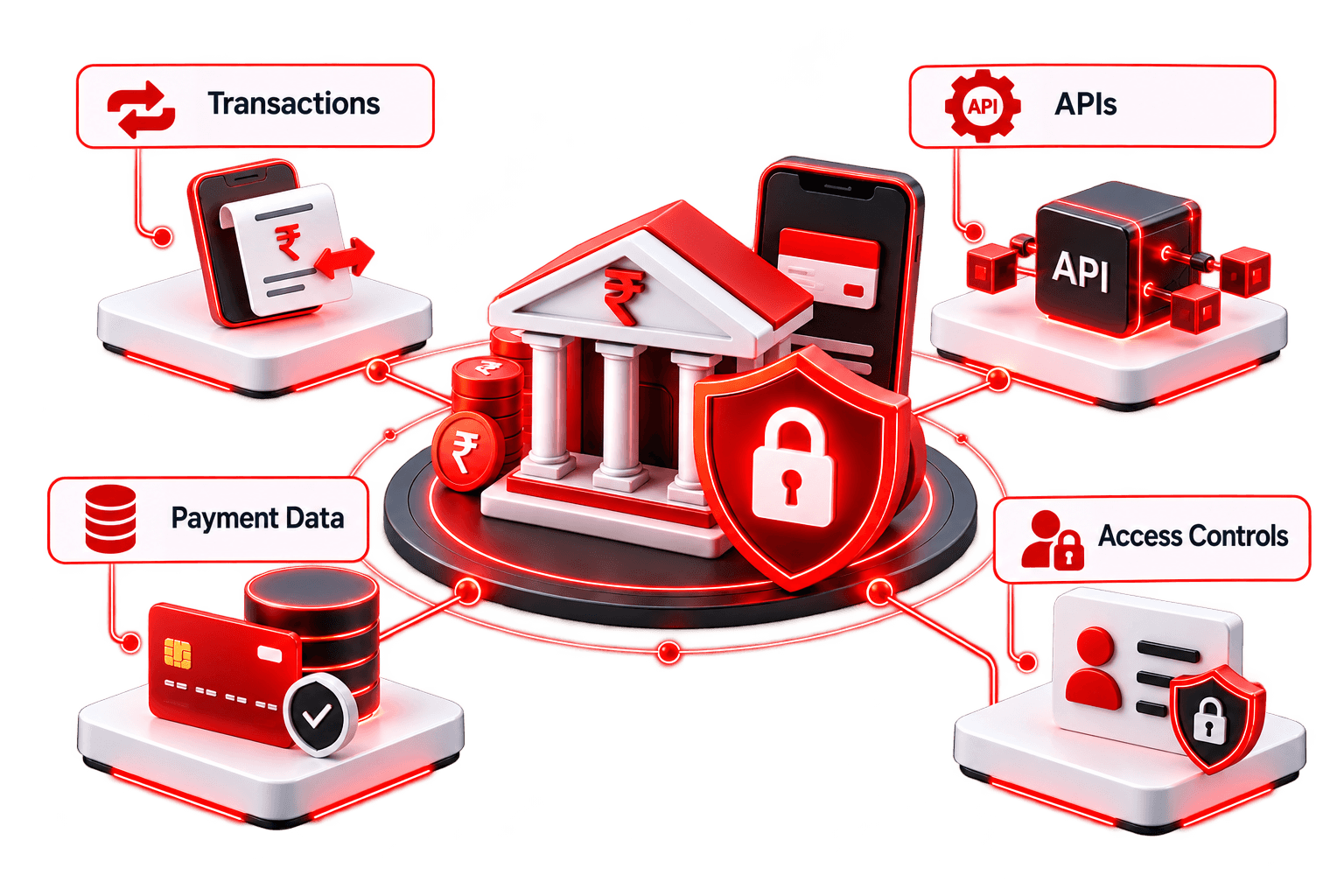
Secure the technology behind every financial interaction. FinTech platforms connect customers with financial products, payment services, accounts, transactions and data through applications, APIs and connected infrastructure — making security more than protecting a login page.
Scope It. Test It. Validate It. Fix It.
Ready to scope a FinTech VAPT engagement? Talk to our VAPT team.
Secure the Technology Behind Every Financial Interaction
FinTech platforms connect customers with financial products, payment services, accounts, transactions and data through applications, APIs and connected infrastructure. That makes security more than protecting a login page.
A FinTech security assessment needs to consider whether users, transactions, permissions, APIs and critical business functions behave as intended under authorized security testing.
NuageSEC provides VAPT and penetration testing across applications, APIs, cloud environments, networks and infrastructure, and currently lists Financial Services & FinTech among its supported industries.
Why FinTech Security Is Different
Financial functionality introduces business-critical security boundaries. FinTech platforms can connect multiple security-sensitive components.
A weakness in one control can matter well beyond a technical component when it affects a financial workflow, sensitive information or customer access. RBI's published FinTech cybersecurity guidance explicitly includes vulnerability assessment and penetration testing as part of periodic assessment of systemic vulnerabilities for FinTech entities.
Transaction Workflows Need Security Validation
Security testing should consider whether an attacker can manipulate the process, bypass an authorization decision, alter sensitive parameters or reach functionality they should not control. OWASP identifies unrestricted access to sensitive business flows as an API security risk because excessive or automated use of sensitive functionality can produce business-specific harm. For FinTech, examples of security-sensitive workflows may include account actions, payment functions, transfers, approvals, beneficiary or payee operations and other financial processes — depending on the product.
Authentication Is Only the First Control
After authentication, access still needs to remain correct. A user successfully signing in does not establish that every subsequent action is authorized.
FinTech Applications May Have Different Access Levels For
A VAPT assessment can therefore examine whether users can reach functions, records or transactions outside their intended permissions. OWASP's API guidance identifies broken object-level authorization and broken function-level authorization as major API risks. Such weaknesses can expose data or allow access to functions intended for other users or roles.
API Security Is FinTech Security
APIs connect the financial ecosystem. Modern FinTech environments may rely heavily on APIs for mobile applications, web applications, payment services, banking integrations, partner platforms, internal microservices and third-party providers.
APIs can expose both data and application functionality, making authorization, authentication, resource access and business-flow controls important security considerations. OWASP's API Security Top 10 specifically covers these areas.
Testing May Examine Whether an Authenticated Customer Can
See how API-specific testing covers authorization, data exposure and business logic. Explore API Security Testing →
Customer Onboarding Is a Security Boundary
The first interaction with a FinTech platform can expose important functionality. The security assessment should consider whether an attacker can manipulate onboarding logic, bypass access controls or reach information and functions intended for another stage of the process.
The objective is not to assume that every FinTech onboarding process has the same risks. It is to test whether the actual workflow enforces the intended security decisions.
FinTech Data Needs More Than Storage Security
Security needs to follow data through the transaction lifecycle. Financial applications may process sensitive information across multiple components.
RBI's digital-payment security requirements state that relevant entities should conduct security testing, including VA/PT, to help assure the security of digital payment applications while preserving confidentiality and integrity of stored and transmitted data.
Security Considerations Can Extend Across
Third-Party and Partner Connections Matter
Your security boundary may extend beyond your own application. FinTech platforms often interact with external services and partners. These connections can introduce additional trust relationships.
OWASP's API Security Top 10 includes Unsafe Consumption of APIs, recognizing risks created when applications trust or consume data and functionality from external APIs. A FinTech assessment should therefore consider relevant integrations where they fall within the authorized scope.
Mobile and Digital Payment Applications
The customer-facing mobile experience can be part of the financial attack surface. RBI's digital-payment security directions explicitly address mobile and internet-banking applications and require security testing, including VA/PT, for applicable digital-payment applications.
Where mobile applications form part of the FinTech product, testing may need to consider the mobile client together with the APIs and backend functionality it relies on.
See how mobile-specific testing covers the client, storage, communication and backend APIs. Explore Mobile Application VAPT →
Cloud and Infrastructure Support the FinTech Platform
Application security does not stop at the application layer. A FinTech platform can depend on cloud services, servers, databases, network components and other supporting systems.
The objective is to understand whether supporting systems introduce attack paths that could affect business-critical applications or services. The scope should reflect the actual architecture and authorized assets — not simply the technology used.
Regulatory and Security Requirements
VAPT can support security assurance, but it does not equal compliance. FinTech companies can operate under different regulatory and contractual requirements depending on their product, jurisdiction and role in the financial ecosystem.
For organizations operating within India's regulated financial environment, RBI has published cybersecurity guidance covering FinTech entities and digital payment applications, including VAPT and security testing requirements in applicable contexts. For securities-market participants, SEBI materials also address cybersecurity, system security and vulnerability/penetration testing requirements for relevant regulated entities and systems.
However: completing a VAPT assessment does not by itself establish regulatory compliance. Compliance depends on the applicable regulation, entity type, control requirements, scope and evidence expected by the relevant authority or customer.
What FinTech VAPT Should Help You Understand
When Should a FinTech Company Consider VAPT?
| Your situation | Recommended starting point |
|---|---|
| New financial application | Validate the product's security boundaries before wider use |
| New payment or transaction workflow | Test authorization and business logic |
| Major API expansion | Assess newly exposed functionality |
| Authentication changes | Validate identity and access controls |
| New third-party integration | Review relevant trust and API boundaries |
| Mobile application launch | Test the mobile-to-backend attack surface |
| Major cloud/infrastructure change | Assess new or exposed supporting assets |
| Enterprise/customer security review | Produce relevant independent assessment evidence |
| Periodic security validation | Reassess the environment as it evolves |
For Indian FinTech entities, RBI's published FinTech security guidance specifically refers to periodic assessment/reassessment through VAPT.
FinTech VAPT Coverage
Web Application VAPT
Assess customer-facing functionality, authentication, authorization, sessions, input handling and business logic.
Explore Web Application VAPTAPI VAPT
Assess API authentication, object and function authorization, data exposure, resource controls and sensitive business flows.
Explore API VAPTMobile Application VAPT
Assess mobile applications and the backend functionality they use.
Explore Mobile Application VAPTCloud VAPT
Assess relevant cloud-hosted components and configurations within the authorized scope.
Explore Cloud VAPTNetwork VAPT
Assess internet-facing and internal network attack surfaces where relevant.
Explore Network VAPTInfrastructure VAPT
Assess supporting systems that form part of the FinTech environment.
Explore Infrastructure VAPTFrequently Asked Questions
What is VAPT for FinTech companies?
VAPT for FinTech companies is an authorized security assessment designed around the attack surface of financial technology platforms. Depending on scope, it may include applications, APIs, authentication, authorization, transaction workflows, mobile applications and supporting infrastructure.
Why is VAPT important for FinTech companies?
FinTech platforms can expose sensitive information and business-critical functionality through applications, APIs and transaction workflows. Security testing helps identify and validate exploitable weaknesses within the agreed scope.
Should transaction workflows be tested during FinTech VAPT?
Where transaction functionality is within scope, business-logic and authorization testing can help determine whether important workflows behave as intended and whether users can perform unauthorized actions.
Should APIs be included in a FinTech security assessment?
Where APIs support financial functionality or expose sensitive information, they are an important part of the assessment scope. OWASP's API Security Top 10 includes authorization, authentication and sensitive-business-flow risks relevant to API-driven applications.
Does FinTech VAPT guarantee regulatory compliance?
No. VAPT can contribute security-testing evidence, but regulatory compliance depends on the specific requirements applicable to the organization, jurisdiction and regulated activity.
How often should FinTech companies perform VAPT?
There is no single interval that applies to every organization. Relevant triggers can include major application or API changes, new transaction workflows, architecture changes, customer requirements and periodic reassessment. RBI's published FinTech guidance refers to periodic VAPT for applicable FinTech entities.
Can mobile applications be included in FinTech VAPT?
Yes, where the mobile application forms part of the authorized assessment scope. For applicable digital-payment environments, RBI's security directions specifically address application security testing, including VA/PT.
Related Topics
Start Your VAPT Assessment
Tell us about your organization. Our VAPT team will get back within one business day to define the right scope and next steps.
