VAPT for SaaS Companies
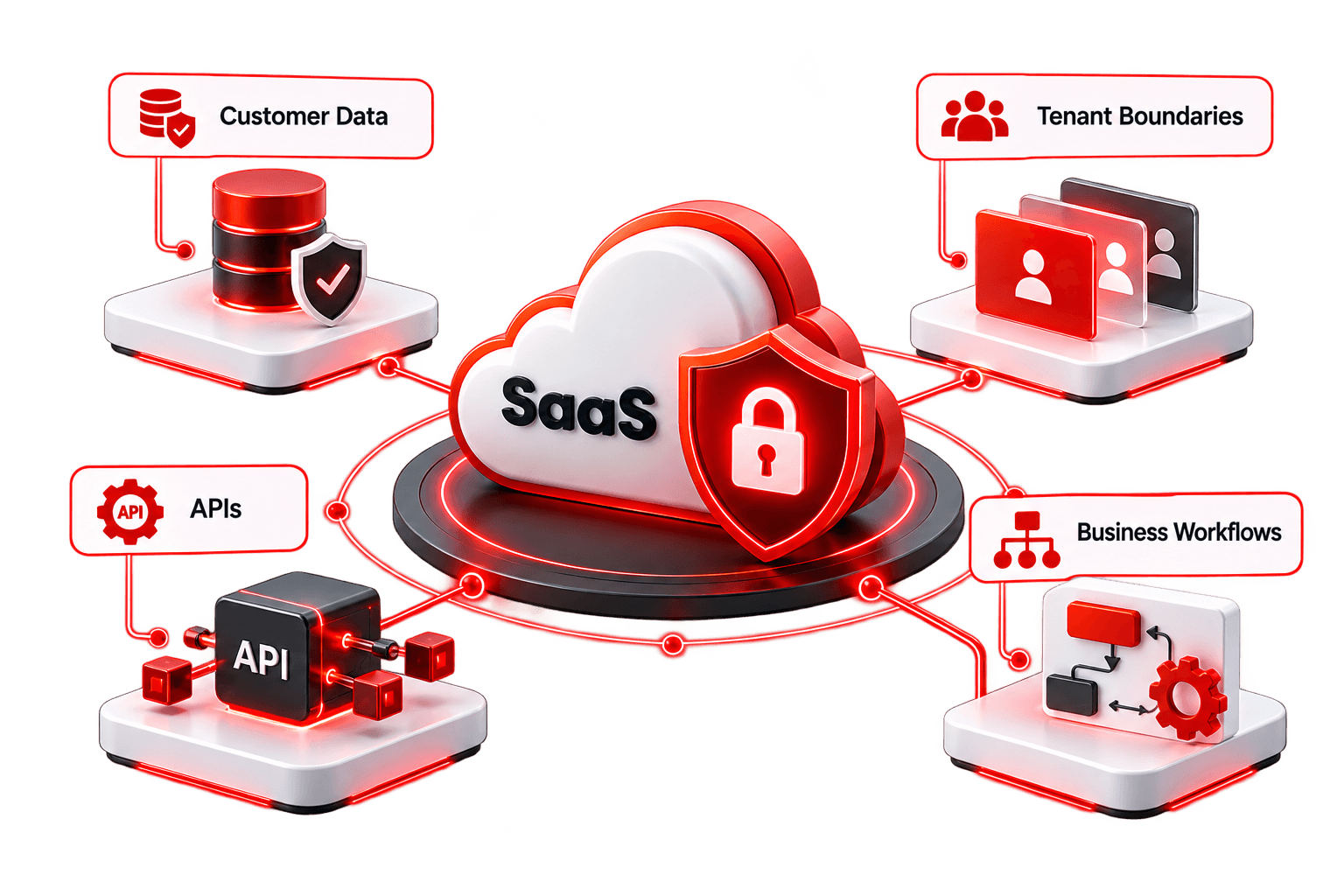
Security for the platform your customers depend on. A SaaS platform serves multiple customer organizations through a connected product, identity model, APIs, integrations and supporting infrastructure — which creates a security challenge beyond protecting a single application: preserving the boundaries between customers, users, roles, resources and business functions.
Scope It. Test It. Validate It. Fix It.
Ready to scope a SaaS VAPT engagement? Talk to our VAPT team.
Security for the Platform Your Customers Depend On
A SaaS platform can serve multiple customer organizations through a connected product, identity model, APIs, integrations and supporting infrastructure. That creates a security challenge beyond protecting a single application: the platform also needs to preserve the boundaries between customers, users, roles, resources and business functions.
NuageSEC provides VAPT and penetration testing for SaaS environments, helping organizations identify security weaknesses across the technology that supports their products and customers. NuageSEC's current VAPT scope includes SaaS platforms alongside web applications, APIs, cloud infrastructure, networks, mobile applications and other infrastructure.
Why SaaS Security Needs an Industry-Specific Approach
SaaS is a business model, not just an application type. A SaaS environment commonly brings together multiple components.
AWS describes the tenant as a fundamental construct in SaaS and emphasizes that tenant context needs to be incorporated into the identity and authorization model. The result is a security environment where customer isolation, authorization and application behavior are closely connected.
The Security Boundary Is the Customer
A valid login does not automatically mean valid access. For SaaS, an important question is not simply “Can the user log in?” It is also “What is that user allowed to access and do after logging in?”
A weakness anywhere in the access chain can create unintended access to customer data, functions or resources. AWS specifically states that authentication alone does not establish tenant isolation and that SaaS architectures need mechanisms to prevent one tenant from accessing another tenant's resources. That makes authorization and tenant boundaries particularly important considerations for SaaS security.
A Simplified SaaS Access Relationship
A weakness in this chain can create unintended access to customer data, functions or resources.
Where SaaS Security Can Affect the Business
The technical weakness matters most when it reaches something the business depends on.
OWASP's API Security Top 10 includes Broken Object Level Authorization, Broken Function Level Authorization and Unrestricted Access to Sensitive Business Flows among its identified API risks.
Multi-Tenant SaaS: Protecting the Boundary Between Customers
Shared infrastructure does not mean shared customer access. Many SaaS architectures serve multiple customers through shared or connected systems. The security objective remains Tenant A → Tenant A Resources, not Tenant A → Tenant B Resources.
AWS identifies tenant isolation as a foundational SaaS concern and notes that isolation strategies can vary according to architecture, compliance requirements and deployment model. This is why SaaS security needs to consider how tenant context is enforced across the platform, not just whether separate user accounts exist.
Detailed tenant-isolation testing belongs on the dedicated SaaS VAPT service page. Explore SaaS VAPT →
APIs Are Part of the SaaS Attack Surface
Customers often interact with more than the visible interface. SaaS products frequently rely on APIs for web applications, mobile applications, integrations, automation and internal services. That means the security controls applied to the product need to remain effective at the API layer as well.
OWASP notes that APIs expose application logic and sensitive data and identifies authorization, authentication, business-flow and resource-consumption risks among API security concerns. For SaaS businesses, an API weakness can therefore become relevant to customer data, user permissions, tenant boundaries, administrative functionality and business operations.
Detailed API testing belongs on the dedicated API VAPT page. Explore API VAPT →
SaaS Products Keep Changing
Security Can Become Part of Enterprise Sales
The customer may evaluate the security behind the product. When SaaS companies sell to enterprise organizations, security can become part of customer due diligence. A prospective customer may request information about penetration testing, application security, API security, authentication and authorization, vulnerability remediation, re-testing and security documentation. Requirements vary by customer and contract.
This makes SaaS security relevant across every one of these functions.
When SaaS Companies Revisit Security Testing
| Your situation | Recommended starting point |
|---|---|
| New product or major launch | Validate important customer-facing attack surfaces |
| Enterprise onboarding | Have relevant, recent security evidence available |
| Major API changes | Reassess newly exposed functionality |
| Authentication or authorization changes | Validate intended access boundaries |
| Tenant architecture changes | Reassess customer isolation |
| Major cloud changes | Review newly introduced or exposed attack paths |
| Significant product changes | Determine whether the security impact warrants testing |
| Recurring validation | Reassess a platform that continues to evolve |
The trigger should be the environment, not an arbitrary checklist.
What VAPT Means for a SaaS Business
| Your situation | Recommended starting point |
|---|---|
| Web-based product | Web Application VAPT |
| API-driven functionality | API VAPT |
| Multi-tenant application | SaaS VAPT |
| Cloud-hosted environment | Cloud VAPT |
| Internet-facing infrastructure | Network VAPT |
| Mobile SaaS application | Mobile Application VAPT |
The assessment should follow the SaaS architecture — not a generic package.
From Vulnerability to Business Context
Published NuageSEC SaaS Experience
Security assessments across SaaS environments.
These cases demonstrate an important point: the right SaaS security scope depends on the product's actual architecture and exposure.
Read the external network assessment in full. View the SaaS External Network Case Study →
Read the AI/SaaS LLM assessment in full. View the AI/SaaS LLM Case Study →
Security Should Scale With the SaaS Business
The platform changes. The security questions change with it. As SaaS platforms grow, they can introduce more customers, users and roles, APIs, integrations, business workflows and security requirements.
The objective is not to assume that a larger SaaS platform is automatically less secure. The objective is to ensure that security validation keeps pace with what the platform exposes and what customers depend on.
Choose Testing Based on the SaaS Environment
SaaS VAPT
For broader validation of the SaaS attack surface and customer-facing security boundaries.
Explore SaaS VAPTMobile Application VAPT
For SaaS products with customer-facing mobile applications.
Explore Mobile Application VAPTWhat SaaS Teams Should Review Before an Assessment
Frequently Asked Questions
What is VAPT for SaaS companies?
VAPT for SaaS companies is an authorized security assessment focused on the attack surface of a SaaS platform. Depending on scope, it can include applications, APIs, authentication, authorization, tenant boundaries and relevant supporting infrastructure.
Why is tenant isolation important in SaaS?
Multi-tenant SaaS platforms serve multiple customer organizations through shared or connected environments. Tenant isolation is intended to prevent one tenant from accessing another tenant's resources. AWS describes tenant isolation as a foundational SaaS concern.
Should APIs be included in SaaS security testing?
Where APIs expose customer data or product functionality, they should be considered as part of the security assessment. OWASP identifies several API-specific authorization and business-flow risks.
Does SaaS VAPT only test the web application?
No. The scope depends on the architecture. SaaS environments can involve applications, APIs, cloud infrastructure, networks, mobile applications and supporting systems.
When should a SaaS company perform VAPT?
There is no single interval that applies to every SaaS platform. Relevant triggers can include major product changes, API changes, authentication or authorization changes, tenant-architecture changes, enterprise customer requirements and periodic security validation.
Can VAPT help with enterprise customer security reviews?
A relevant and recent penetration-testing assessment can provide security evidence that may be requested during customer due diligence. Exact requirements vary by customer and contract.
Does VAPT guarantee that a SaaS platform is secure?
No. A penetration test provides findings based on its defined scope, methodology, access and testing conditions. It does not guarantee that no undiscovered vulnerabilities exist.
Related Topics
Start Your VAPT Assessment
Tell us about your organization. Our VAPT team will get back within one business day to define the right scope and next steps.
