VAPT for Banks
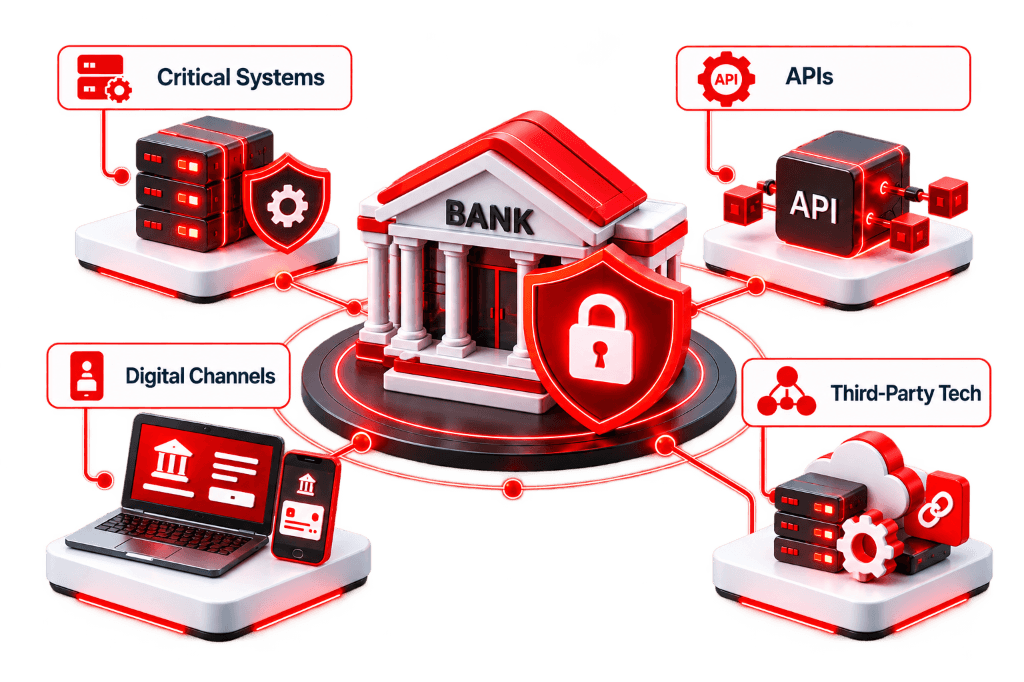
Security testing for the systems customers depend on every day. Banks operate through interconnected applications, APIs, identities, infrastructure, digital channels and third-party technology — so the challenge isn't simply finding vulnerabilities, it's understanding whether a weakness could cross an intended access boundary, expose sensitive information, affect a critical system or create an exploitable path through the banking environment.
Scope It. Test It. Validate It. Fix It.
Ready to scope a banking VAPT engagement? Talk to our VAPT team.
Security Testing for the Systems Customers Depend On Every Day
Banks operate through interconnected applications, APIs, identities, infrastructure, digital channels and third-party technology. The challenge is not simply finding vulnerabilities.
It is understanding whether a weakness could cross an intended access boundary, expose sensitive information, affect a critical system or create an exploitable path through the banking environment.
NuageSEC provides VAPT across web applications, APIs, cloud environments, networks and infrastructure, and currently identifies Financial Services & FinTech among the industries it serves.
Banking Security Is a System Problem
The customer sees a banking application. The bank operates an ecosystem. A banking environment may connect:
A weakness in an API can affect application access. A compromised identity can expose privileged functions. An exposed network service can create an entry point into supporting infrastructure. A third-party connection can introduce another trust boundary. The relevant question is therefore: where can an attacker move from the weakness discovered to something the bank needs to protect? RBI's 2026 commercial-bank framework addresses cybersecurity and technology risk across areas including information assets, application security, user access, third-party arrangements, vulnerability management, incident response and resilience.
Digital Banking Has Moved the Security Boundary
Internet banking and mobile banking are only the visible layer. Each layer in a customer interaction introduces different security controls and attack paths — a customer-facing application can therefore appear secure while a weakness in an underlying API, authorization control or supporting component creates unintended access.
For commercial banks in India, RBI's Digital Payment Security Controls Directions, 2026 apply to digital payment products and services offered by commercial banks and associated IT assets, including applications, systems and infrastructure. The Directions address application security, authentication, risk management and security controls for digital payment services.
The Important Question After Login
Authentication establishes identity. Authorization determines what that identity can do. Banking systems may have multiple user populations and privilege levels.
A security assessment needs to consider whether each identity can access only the accounts, records, functions and systems intended for that role. OWASP identifies Broken Object Level Authorization and Broken Function Level Authorization as major API security risks, where inadequate authorization can expose objects or functions beyond the user's intended privileges. The banking question: can a legitimate user become unauthorized through a change in object, role, function or request context?
Banking APIs Need Business-Context Testing
An API can expose a capability even when the user never sees it directly. APIs can support mobile banking, internet banking, internal applications, partner integrations, payment services, customer-service functions and backend services.
OWASP's API Security Top 10 covers risks including broken object authorization, broken function authorization, unrestricted access to sensitive business flows, improper API inventory management and unsafe consumption of APIs.
For a Banking Environment, API Testing Should Ask
See how API-specific testing covers authorization, data exposure and business logic. Explore API Security Testing →
Transaction Security Is About the Entire Workflow
Protecting the transaction means testing the decisions around it. A security weakness can occur when one of those decisions is bypassed or manipulated.
The objective is not to assume that every bank has the same transaction risks. It is to test whether the actual workflow enforces the security rules the bank expects it to enforce.
Examples of Areas to Assess, Where Applicable
Critical Systems Cannot Be Treated Like Ordinary Assets
Testing scope should reflect system criticality. Not every system in a bank has the same business significance — a critical customer-facing system may require a very different level of testing attention from an isolated internal application.
The RBI 2026 Commercial Banks Cybersecurity Directions require banks to conduct VA/PT periodically for critical and internet-facing systems. For critical information systems and/or DMZ systems with a customer interface, VA is required at least once every six months and PT at least once every 12 months. The Directions also require lifecycle testing, including pre-implementation, post-implementation and after major changes. Non-critical systems follow a risk-based approach.
This creates a practical requirement for security teams: know which systems are critical, which are internet-facing, what has changed, and what testing is required for each.
Banking Security Has to Account for Change
A major technology change can change the attack surface. A change does not automatically mean a full new VAPT engagement — but it should trigger a security question: did the change alter an important attack path, security boundary, customer interface or critical system?
RBI's 2026 Directions specifically require applicable VA/PT throughout the system lifecycle and after major changes.
Third-Party Technology Extends the Security Boundary
The bank may not own every system connected to its operations. Banks can depend on external technology providers for applications, infrastructure, cloud services, maintenance and other IT services.
Banking Security Is Also an Operational-Continuity Question
The impact of a weakness depends on the system it affects. A vulnerability affecting an isolated internal application may present a different business concern from the same class of weakness affecting a customer-facing critical system.
RBI's 2026 framework places cybersecurity alongside technology risk, resilience, business continuity and incident response, reinforcing that security needs to be considered within the broader operational environment. The actual impact depends on the affected system and attack path — not every vulnerability “threatens banking operations.”
Automated Scanning Is Not the Whole Assessment
A vulnerability scanner can identify exposure. It does not always establish what an attacker can actually achieve. Automated assessment can help identify known vulnerable software, missing patches, weak configurations and exposed services.
Banking Applications May Also Contain Weaknesses Requiring Manual Testing
NuageSEC currently describes its VAPT approach as combining vulnerability identification with ethical exploitation and manual validation to help establish real-world impact and prioritise remediation.
What Banking VAPT Can Cover
Digital Banking
Web applications and customer-facing banking functionality.
Explore Web Application VAPTAPI Security
Authentication, authorization, data exposure and sensitive business functions.
Explore API VAPTNetwork Security
Internet-facing and internal network attack surfaces where authorized.
Explore Network VAPTInfrastructure
Servers, databases, identity systems and other supporting components.
Explore Infrastructure VAPTRBI 2026: What Banking Security Teams Need to Know
The regulatory framework changed in 2026. For commercial banks in India, the RBI's Commercial Banks — Cybersecurity, Technology: Risk, Resilience and Assurance Framework Directions, 2026 took effect on July 31, 2026.
For VA/PT, the Directions Require
Digital Payment Security Has Its Own Requirements
Banking VAPT may intersect with a separate digital-payment security framework. RBI issued the Commercial Banks — Digital Payment Security Controls Directions, 2026 on July 31, 2026, applying to commercial banks and their digital payment products and services, including associated IT assets.
A bank may have general cybersecurity VA/PT requirements and separately, digital-payment security requirements. The applicable scope depends on the bank and the service being assessed.
What a Banking VAPT Report Should Help You Decide
When Should a Bank Reassess Security?
| Your situation | Recommended starting point |
|---|---|
| New digital banking application | Customer-facing exposure and access controls |
| Major application upgrade | Newly introduced attack paths |
| New API or banking integration | Authorization and data-access boundaries |
| Authentication redesign | Identity, session and privilege controls |
| Major cloud migration | Cloud exposure and supporting infrastructure |
| Network architecture change | External and internal attack surface |
| New third-party technology | Trust, access and data boundaries |
| Major security remediation | Whether the weakness has actually been resolved |
| Critical-system lifecycle event | Applicable VA/PT requirement and scope |
| Material system change | Whether renewed testing is required |
RBI's 2026 commercial-bank Directions explicitly require VA/PT throughout the lifecycle of applicable systems and after major changes.
Questions to Answer Before Starting a Banking VAPT
Banking VAPT Is Not a Security Guarantee
A penetration test provides evidence within a defined scope. A VAPT assessment cannot establish that a bank has no vulnerabilities.
Its Conclusions Are Based On
Its value is in providing evidence about identified weaknesses, exploitable paths, affected systems and remediation needs. That distinction is especially important for regulated organizations where security evidence needs to be precise and defensible.
See how NuageSEC approaches VAPT for organizations operating in India. Explore VAPT Testing in India →
Review examples of NuageSEC's reporting approach. View Sample VAPT Reports →
Frequently Asked Questions
What is VAPT for banks?
VAPT for banks is an authorized security assessment designed around the bank's applications, APIs, networks, infrastructure, cloud environments and other systems included within the agreed scope.
How is banking VAPT different from a generic penetration test?
Banking VAPT needs to consider the technology and operational context of banking, including customer-facing systems, critical information systems, digital banking channels, privileged access, third-party technology and applicable regulatory requirements.
How often do commercial banks need VAPT?
Under RBI's 2026 Commercial Banks Cybersecurity Directions, VA/PT is required periodically for critical and internet-facing systems. For critical information systems and/or DMZ systems with customer interfaces, VA is required at least every six months and PT at least every 12 months. Non-critical systems follow a risk-based approach.
Does RBI require testing after major changes?
For applicable critical and internet-facing web/mobile applications, servers and network components, RBI's 2026 Directions require VA/PT throughout the lifecycle, including after changes.
Should APIs be included in banking VAPT?
Where APIs provide access to banking information or functionality, they should be considered within the assessment scope. OWASP identifies authorization and sensitive-business-flow risks among its major API security concerns.
Does banking VAPT include mobile applications?
It can, where mobile applications are within the authorized assessment scope. RBI's 2026 digital-payment framework specifically addresses mobile-payment application security for applicable commercial-bank services.
Can critical banking systems be tested in production?
RBI's 2026 Commercial Banks Directions state that post-implementation VA/PT should be performed on the production environment; under unavoidable circumstances, testing in a test environment is permitted subject to the conditions specified in the Directions, including similarity to production and documented approval of deviations.
Does VAPT guarantee RBI compliance?
No. VAPT can provide technical assessment evidence relevant to applicable requirements, but compliance depends on the bank's complete regulatory, governance, security and control environment.
Can third-party systems be included in banking VAPT?
Where the bank has the appropriate authorization and the systems fall within the agreed scope, relevant third-party connections and interfaces can be assessed. The exact scope depends on the relationship, technology and authorization.
Is vulnerability assessment the same as penetration testing?
No. Vulnerability assessment focuses on identifying security weaknesses, while penetration testing attempts to validate exploitability and potential impact under controlled conditions.
Does VAPT prevent all banking attacks?
No. VAPT provides evidence based on the assessed scope and testing conditions. It cannot guarantee protection from future vulnerabilities, zero-day attacks, credential compromise or out-of-scope attack paths.
Related Topics
Start Your VAPT Assessment
Tell us about your organization. Our VAPT team will get back within one business day to define the right scope and next steps.
