VAPT for Healthcare
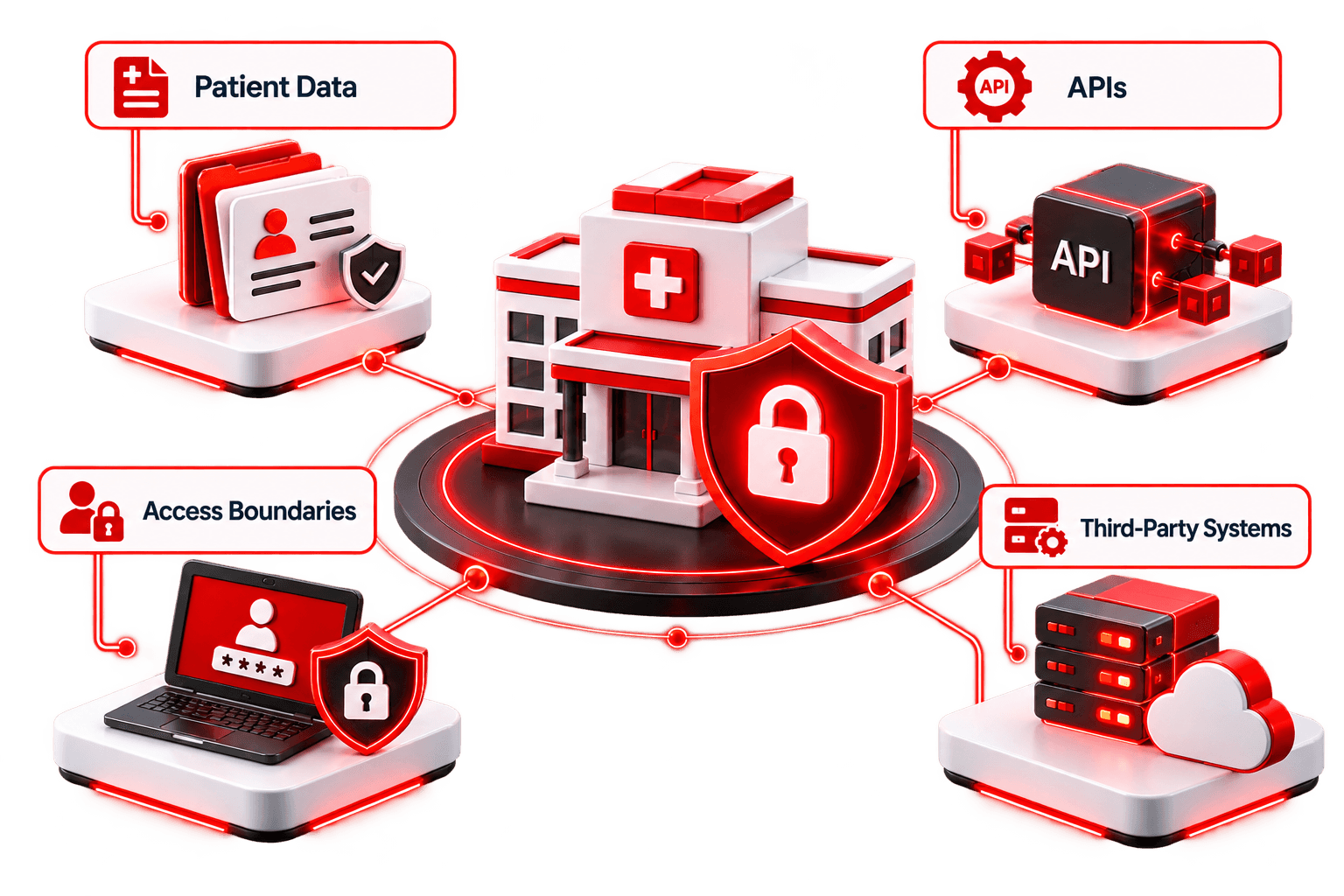
Protect the systems behind patient care. Healthcare organizations operate across applications, patient-facing portals, APIs, connected systems, cloud environments, internal infrastructure and third-party services — so a security weakness can affect access to healthcare systems, operational continuity and clinical workflows, not just sensitive information.
Scope It. Test It. Validate It. Fix It.
Ready to scope a healthcare VAPT engagement? Talk to our VAPT team.
Protect the Systems Behind Patient Care
Healthcare organizations operate across applications, patient-facing portals, APIs, connected systems, cloud environments, internal infrastructure and third-party services. The security challenge is therefore not limited to protecting sensitive information.
A security weakness can also affect access to healthcare systems, operational continuity, clinical workflows and the services teams rely on every day.
NuageSEC provides VAPT across applications, APIs, cloud, networks, mobile applications and infrastructure, and its current industry portfolio includes healthcare providers.
Why Healthcare Security Has a Different Risk Context
A healthcare environment has to protect data and keep important systems usable. Healthcare environments can contain:
HHS describes cybersecurity in the healthcare and public-health sector in terms of protecting patient health information and safety, while its Cybersecurity Performance Goals emphasize practices intended to improve cyber preparedness and resilience. That creates a different security question: what happens to patient care and healthcare operations if a critical system becomes compromised or unavailable?
The Problem Healthcare Teams Are Actually Dealing With
Security is rarely limited to one application. A healthcare security team may have to understand risk across:
A hospital may depend on numerous vendors, while the security relevance of a vendor depends not only on the data it handles but also on how deeply it is connected to operational and patient-care processes — an industry/community observation rather than a formal regulatory requirement.
Patient Data Is Only Part of the Risk
Healthcare APIs Can Become a Direct Path to Patient Data
The interface may expose more than the screen shows. Healthcare applications increasingly rely on APIs to exchange information between applications, services and integrations.
An API May Provide Access To
OWASP identifies Broken Object Level Authorization, Broken Authentication, Broken Function Level Authorization, Unrestricted Access to Sensitive Business Flows and Security Misconfiguration among its API Security Top 10 risks. For a healthcare organization, an authorization weakness can therefore become a data-access problem rather than simply an API defect. A practical question for the security team: does the API enforce the same patient, user and role boundaries that the application intends to enforce?
Healthcare Security Is Also About Access Boundaries
Healthcare environments have many legitimate users. The security concern is not simply “Can this person authenticate?” It is “Can this person access only what their role and workflow require?”
Security testing can examine whether authorization controls prevent users from reaching records, functions or resources outside their intended permissions. NuageSEC's published healthcare assessment identified broken access control and IDOR-related API issues that allowed unauthorized access to records and sensitive information.
Healthcare Systems Cannot Always Be Treated Like Ordinary IT Systems
Availability has operational consequences. Healthcare security decisions often have to account for operational continuity. The Department of Health and Human Services' healthcare cybersecurity work explicitly frames cyber resilience around protecting patient health information and safety. HHS/FDA guidance on medical-device cybersecurity also discusses the potential impact of cybersecurity incidents on clinical care and patient safety.
This does not mean every vulnerability will affect patient care. It means the assessment context matters. A finding affecting an isolated non-critical system may have a very different consequence from one affecting a system that supports an important healthcare workflow.
Third-Party Connections Create Another Security Boundary
The healthcare environment often extends beyond the organization's own systems. Healthcare organizations may depend on external technology providers for services such as:
The HHS Hospital Cyber Resiliency Landscape Analysis identifies supply-chain risk as a significant concern and notes that hospitals reported extensive dependence on third-party systems. For VAPT, this means in-scope third-party interfaces and integrations should be considered according to authorization and the agreed assessment boundary.
Medical Devices Need Context, Not Generic Testing Claims
Connected healthcare technology can introduce additional security considerations. HHS/FDA cybersecurity guidance notes that vulnerabilities in commonly used components have created potential cybersecurity and safety concerns for medical devices, and emphasizes lifecycle-based cybersecurity considerations.
However, not every healthcare VAPT engagement should automatically become a medical-device security assessment. This distinction keeps healthcare VAPT realistic rather than turning every engagement into a device-security claim.
The Appropriate Scope Depends On
Healthcare Applications Need Security Testing Around Real Workflows
Security testing can examine whether controls remain effective throughout that process.
Healthcare Security Testing Should Minimize Operational Risk
The testing approach has to respect the environment being tested. Healthcare systems can be operationally sensitive, so an assessment needs clearly defined boundaries.
The objective is to obtain meaningful security evidence while keeping testing within the agreed operational boundaries. HHS's healthcare cybersecurity guidance emphasizes organizations adapting safeguards and risk-management measures to the characteristics of their own environment rather than following a one-size-fits-all model.
VAPT Should Answer Healthcare-Specific Questions
Healthcare VAPT Across the Technology Environment
Web Application VAPT
For patient portals, healthcare applications, provider-facing applications and other authorized web environments.
Explore Web Application VAPTAPI VAPT
For APIs connecting applications, systems, integrations and healthcare data.
Explore API VAPTMobile Application VAPT
For healthcare mobile applications and the backend services they rely on.
Explore Mobile Application VAPTCloud VAPT
For authorized cloud environments supporting healthcare applications and data.
Explore Cloud VAPTInfrastructure VAPT
For servers, identity services, databases and other supporting systems.
Explore Infrastructure VAPTHIPAA and VAPT: An Important Distinction
Security testing can support risk management. It does not automatically equal HIPAA compliance. For organizations covered by HIPAA, the Security Rule includes requirements related to risk analysis and risk management for ePHI. HHS states that risk analysis is foundational to identifying and implementing appropriate safeguards.
A VAPT assessment can contribute evidence about technical vulnerabilities and security controls within its defined scope. But VAPT ≠ HIPAA compliance — compliance depends on the organization's applicable requirements, safeguards, policies, processes, risk analysis and other controls.
See how VAPT fits into a broader compliance program. Explore Compliance Services →
When Healthcare Organizations Revisit VAPT
| Your situation | Recommended starting point |
|---|---|
| New patient-facing application | Are important externally accessible functions secure? |
| New API or integration | Are access and data boundaries enforced? |
| Authentication changes | Are identity and authorization controls still working as intended? |
| Major application release | Did the change introduce new security exposure? |
| Cloud migration or major cloud change | Have new attack paths or exposed services appeared? |
| Network architecture change | Has the external or internal attack surface changed? |
| New third-party integration | Has a new trust or data boundary been introduced? |
| Significant security remediation | Have previously identified weaknesses been effectively addressed? |
| Periodic reassessment | Has the environment changed since the previous assessment? |
HHS's HIPAA Security Rule guidance requires regulated entities to periodically evaluate the effectiveness of security measures and regularly reevaluate potential risks.
What a Healthcare VAPT Report Should Give the Team
A Real Healthcare Finding: One Published Assessment Shows Why API Security Matters
NuageSEC's published healthcare case study concerns a USA-headquartered healthcare organization with 100–500 employees.
The Documented Attack Path
NuageSEC states that remediation included stronger authorization validation, object-level access controls, reduced sensitive data exposure and improved authentication/session controls. This is a useful healthcare example because it connects an API security weakness to unauthorized access to healthcare records, rather than presenting an abstract vulnerability list.
Read the full findings, evidence and remediation guidance. Read the Healthcare API Case Study →
What Healthcare Teams Should Establish Before Testing
Healthcare Security Is About More Than Finding Vulnerabilities
The bigger question is what the weakness could affect. For a healthcare organization, security teams may need to balance:
HHS's HIPAA Security Rule centers risk analysis on the confidentiality, integrity and availability of ePHI, while its healthcare-sector cybersecurity program also emphasizes resilience and patient safety.
Frequently Asked Questions
What is VAPT for healthcare?
VAPT for healthcare is an authorized security assessment designed around the technology environment of a healthcare organization. Depending on the agreed scope, it can include web applications, APIs, mobile applications, cloud environments, networks and supporting infrastructure.
Why is penetration testing important for healthcare organizations?
Healthcare organizations depend on interconnected systems that can process sensitive information and support important operations. VAPT can help identify and validate exploitable weaknesses within the defined testing scope.
What does healthcare VAPT typically test?
The scope depends on the environment. It may include patient-facing applications, APIs, authentication and authorization controls, business workflows, cloud environments, networks, mobile applications and infrastructure.
Should healthcare APIs be tested separately?
Where APIs provide access to healthcare information or application functionality, they should be considered as part of the security scope. OWASP identifies several API-specific authorization, authentication and business-flow risks.
Does healthcare VAPT test medical devices?
Not automatically. Medical-device testing requires an appropriately defined scope and safety considerations. In some engagements, the relevant assessment may instead focus on the applications, APIs, management interfaces, networks or infrastructure connected to those devices.
Does VAPT make an organization HIPAA compliant?
No. VAPT can contribute technical evidence to a security and risk-management program, but HIPAA compliance involves the applicable Security Rule requirements and the organization's broader safeguards and processes.
Can VAPT be performed without disrupting healthcare operations?
Testing should be planned around the authorized scope, rules of engagement, testing windows, exclusions and operational constraints. The specific approach depends on the environment and systems involved.
How often should healthcare organizations perform VAPT?
There is no single interval appropriate for every healthcare environment. Testing frequency should take into account risk, significant changes, applicable requirements and the organization's security program. HIPAA's Security Rule includes requirements for periodic evaluation and reassessment of risks for regulated entities.
Can VAPT identify patient-record exposure through APIs?
Yes, where the relevant API is within the authorized scope. NuageSEC publicly documents a healthcare assessment in which API authorization weaknesses enabled unauthorized access to patient records.
Related Topics
Start Your VAPT Assessment
Tell us about your organization. Our VAPT team will get back within one business day to define the right scope and next steps.
