Enterprise Cybersecurity Services to Protect Your Business & Reduce Cyber Risk
Stay Ahead of Cyber Threats with Enterprise Cybersecurity Services Built for Modern Businesses.
Align Security Services With Your Business Objectives
Most organizations don't begin with a specific security service. They begin with a business objective. Our cybersecurity specialists align every engagement with the outcome your organization needs to achieve.
Prepare for a SOC 2 audit
Recommended SolutionSecurity assessment, penetration testing, remediation guidance
Achieve ISO 27001 readiness
Recommended SolutionVulnerability assessment, penetration testing, compliance mapping
Secure a web application before release
Recommended SolutionWeb Application Security Testing
Protect public APIs
Recommended SolutionAPI Security Testing
Strengthen cloud security
Recommended SolutionCloud Security Assessment
Validate internal and external infrastructure
Recommended SolutionNetwork Penetration Testing
Improve security visibility
Recommended SolutionManageEngine Implementation & Consulting
Reduce enterprise cyber risk
Recommended SolutionEnterprise Cybersecurity Assessment
Navigating Today's Complex Cybersecurity Landscape
Digital transformation has expanded the attack surface for nearly every organization. Cloud infrastructure, remote workforces, SaaS platforms, APIs, mobile applications, third-party integrations, and connected devices have introduced new opportunities for cybercriminals to exploit weaknesses.
At the same time, customers, regulators, insurers, and business partners increasingly expect organizations to demonstrate strong cybersecurity practices. Security is no longer viewed solely as an IT responsibility—it is a core business requirement that influences operational continuity, customer trust, regulatory compliance, and commercial growth.
Rather than relying on isolated security activities, organizations benefit from a structured cybersecurity program that combines continuous assessment, expert validation, remediation guidance, and ongoing improvement.
NuageSEC delivers a comprehensive portfolio of enterprise cybersecurity services designed to help organizations manage cyber risk across applications, cloud environments, networks, APIs, endpoints, and critical business systems.
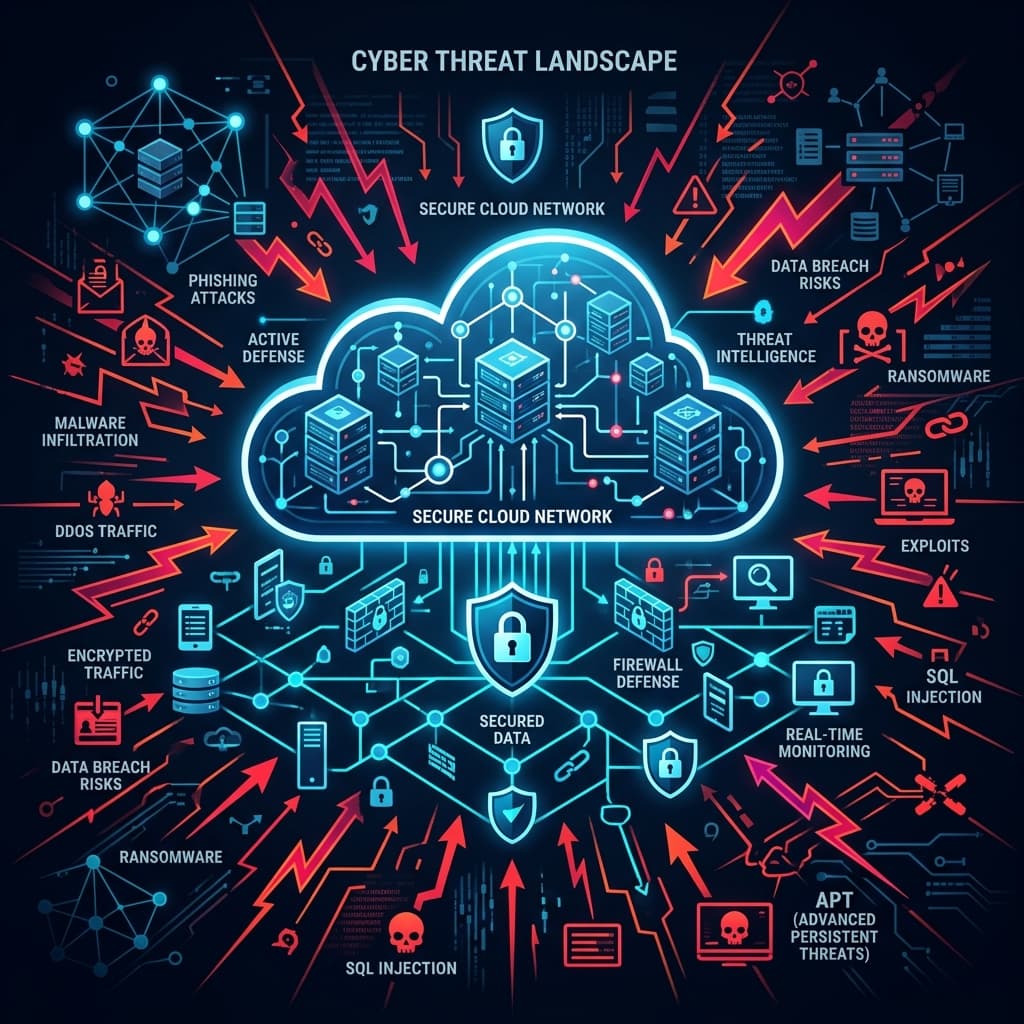
Why Organizations Choose Enterprise Cybersecurity Services
Cybersecurity is no longer about responding to incidents after they occur. The most effective organizations continuously assess their environments, validate security controls, and address vulnerabilities before they become business disruptions. Every assessment is designed to provide practical recommendations that help security, engineering, and leadership teams make informed decisions.
Comprehensive Enterprise Cybersecurity Services
Modern cyber threats require more than isolated security assessments. Organizations need an integrated cybersecurity strategy that identifies vulnerabilities, validates security controls, supports regulatory compliance, and enables secure business growth.
NuageSEC provides enterprise cybersecurity services that combine technical expertise, industry-recognized methodologies, and actionable remediation guidance to help organizations reduce cyber risk across applications, infrastructure, cloud environments, APIs, networks, and business-critical systems.
Whether you are securing a new digital product, preparing for a compliance audit, protecting customer data, or strengthening your overall security posture, our services are designed to address both immediate security challenges and long-term resilience.
Vulnerability Assessment and Penetration Testing (VAPT)
Cybercriminals continuously scan internet-facing systems, applications, APIs, and networks for exploitable vulnerabilities. Even a single overlooked weakness can lead to unauthorized access, data breaches, ransomware incidents, or regulatory penalties. Our Vulnerability Assessment and Penetration Testing (VAPT) services help organizations proactively identify, validate, and prioritize security vulnerabilities before they become business risks. Unlike automated scanning alone, our approach combines advanced vulnerability assessment with manual penetration testing performed by experienced security professionals to determine the real-world impact of identified weaknesses.
Penetration Testing Services
Security controls cannot be considered effective until they have been tested against realistic attack scenarios. Our penetration testing services simulate the techniques, tactics, and procedures used by real attackers to identify exploitable weaknesses across your digital environment. Rather than simply reporting vulnerabilities, we demonstrate how weaknesses could be chained together to compromise systems, helping organizations understand true business impact.
Web Application Security Testing
Web applications are among the most frequently targeted attack surfaces because they process sensitive customer information, financial transactions, and business-critical operations. Our Web Application Security Testing service combines automated analysis with expert manual testing to identify vulnerabilities that scanners frequently miss, including business logic flaws and complex authorization issues. Testing is aligned with the latest OWASP Web Security standards and focuses on vulnerabilities that present measurable business risk.
API Security Testing
APIs connect applications, cloud platforms, mobile experiences, payment gateways, and third-party services. As organizations become increasingly API-driven, protecting these interfaces is critical. Our API Security Testing service evaluates REST, GraphQL, SOAP, and other APIs to identify vulnerabilities related to authentication, authorization, input validation, data exposure, and business logic. Testing follows the OWASP API Security Top 10 framework and includes practical remediation guidance.
Cloud Security Assessment
Cloud environments introduce unique security challenges, including identity management, misconfigured storage, excessive permissions, insecure networking, and compliance risks. Our Cloud Security Assessments evaluate cloud environments against recognized security best practices to help organizations strengthen governance and reduce exposure.
Network Security Assessment
Networks remain a primary target for attackers seeking unauthorized access to business systems. Our assessments evaluate infrastructure security, segmentation, remote access, firewall configuration, Active Directory security, wireless networks, and privileged access controls to identify weaknesses before they can be exploited.
Source Code Security Review
Many vulnerabilities originate during software development and cannot be detected through infrastructure testing alone. Our Source Code Security Review examines application code for insecure programming practices, authentication weaknesses, authorization flaws, insecure cryptography, improper input validation, and business logic vulnerabilities. Security recommendations help development teams build secure applications while reducing future remediation costs.
Red Team Assessment
Traditional penetration testing identifies vulnerabilities. Red Team engagements evaluate an organization's ability to detect, respond to, and contain sophisticated attacks by simulating real-world adversary behavior. These engagements assess people, processes, and technology through realistic attack scenarios aligned with business objectives.
Security Operations Center (SOC) Services
Cyber threats operate continuously around the clock. Our Security Operations Center (SOC) Services deliver 24x7 threat monitoring, SIEM log correlation, threat detection, incident triage, and proactive containment across your endpoints, cloud services, and enterprise infrastructure to limit dwell time and protect business assets.
Incident Response & Digital Forensics Services
Cyber incidents can disrupt business operations within minutes. Our Incident Response & Digital Forensics Services help organizations rapidly contain threats, preserve evidence, investigate root causes, and restore operations while minimizing business disruption.
Cybersecurity Risk Assessment Services
Our Cybersecurity Risk Assessment Services provide a comprehensive evaluation of your organization's cybersecurity posture by identifying vulnerabilities, assessing threats, evaluating existing security controls, and developing a practical roadmap to reduce cyber risk.
Managed Detection & Response (MDR) Services
Our Managed Detection & Response (MDR) Services combine experienced security analysts, advanced detection technologies, threat intelligence, and structured response procedures to provide 24x7 protection across endpoints, networks, cloud environments, and identities.
Why These Services Work Together
Organizations rarely face a single cybersecurity challenge. A secure web application can still be compromised through a vulnerable API, a misconfigured cloud environment, or weak identity controls. Likewise, meeting a compliance requirement often depends on multiple assessments working together rather than one standalone test.
NuageSEC's service portfolio is designed as an integrated security program. Vulnerability assessments identify potential weaknesses, penetration testing validates real-world exploitability, application and API security testing protect customer-facing systems, cloud and network assessments strengthen infrastructure, and secure code reviews reduce risk during development. Together, these services provide a complete view of your security posture and support continuous improvement rather than one-time testing.
Achieve Compliance with Confidence Through Security Assessments That Support Global Standards
Meeting regulatory and industry security requirements requires more than documentation. Organizations must demonstrate that critical systems have been independently assessed, vulnerabilities identified, risks addressed, and security controls validated. NuageSEC helps organizations strengthen their compliance readiness through comprehensive cybersecurity assessments aligned with internationally recognized frameworks. Our services support security teams, compliance officers, auditors, and leadership by providing technical testing, detailed reporting, and practical remediation guidance. Whether you are preparing for a first-time certification, maintaining an existing certification, responding to customer security questionnaires, or addressing audit findings, our security experts help reduce compliance risk through structured testing and evidence-based reporting.
SOC 2 Security Assessments
Demonstrate your organization's commitment to protecting customer data and meeting the Trust Services Criteria. Our assessments help organizations identify technical security gaps before external audits, validate security controls, and improve readiness for customer due diligence and vendor risk assessments.
Typical Services Involved:
- Web Application Penetration Testing
- API Security Testing
- Internal Network Assessment
- External Network Assessment
- Cloud Security Review
Why Compliance-Focused Security Matters
Compliance is no longer just about satisfying auditors. Customers, investors, insurers, regulators, and business partners increasingly expect organizations to demonstrate measurable cybersecurity maturity. A proactive security assessment helps organizations reduce regulatory risk, strengthen customer trust, improve audit readiness, and support long-term operational resilience.
Tailored Cybersecurity Solutions Across Verticals
Every industry faces unique cybersecurity challenges driven by regulatory requirements, digital transformation, evolving attack techniques, and business-critical operations. NuageSEC delivers industry-focused cybersecurity services that address sector-specific risks while supporting operational continuity and regulatory compliance.
SaaS & Technology
Protect customer platforms, APIs, cloud infrastructure, authentication systems, and multi-tenant environments while supporting rapid software development.
Manufacturing
Secure production systems, operational technology environments, industrial networks, and connected manufacturing infrastructure against modern cyber threats.
Financial Services & FinTech
Strengthen digital banking platforms, payment systems, APIs, and customer-facing applications while supporting security and compliance requirements.
Healthcare
Protect electronic health records, patient portals, connected medical devices, and healthcare applications through comprehensive security testing.
Retail & Ecommerce
Reduce the risk of payment fraud, account compromise, data breaches, and application vulnerabilities across online and physical retail environments.
Logistics & Supply Chain
Secure transportation systems, warehouse applications, IoT environments, vendor integrations, and operational platforms.
Government & Public Sector
Strengthen cybersecurity across citizen services, digital infrastructure, and mission-critical systems while supporting regulatory obligations.
Professional Services
Protect client information, confidential business data, collaboration platforms, and cloud-based business applications.
Supporting Global Enterprises
Organizations across the world face increasingly complex cybersecurity threats, evolving regulations, and heightened customer expectations. NuageSEC provides enterprise cybersecurity services to organizations operating across multiple regions while adapting testing methodologies and reporting to local business and regulatory requirements.
We also support multinational organizations that require consistent security assessments across multiple business locations and technology environments.
A Structured Approach to Cyber Resilience
A structured methodology ensures every engagement is repeatable, measurable, and aligned with recognized security standards.
Why Our Methodology Delivers Better Outcomes
Our approach goes beyond identifying vulnerabilities. Every engagement is designed to produce actionable intelligence that helps organizations strengthen security, accelerate remediation, demonstrate compliance, and make informed risk-based decisions.
By combining automated analysis, expert manual validation, recognized security frameworks, and business-focused reporting, we deliver assessments that support both technical teams and executive stakeholders.
Enterprise Cybersecurity Expertise That Goes Beyond Vulnerability Reports
Selecting a cybersecurity partner is not simply about identifying vulnerabilities. The value comes from understanding business impact, providing practical remediation guidance, supporting compliance objectives, and helping organizations continuously improve their security posture.
What You Receive
Every engagement provides clear documentation that supports technical remediation, executive reporting, and compliance initiatives.
Aligned With Recognized Cybersecurity Standards
Our methodologies align with recognized cybersecurity standards, secure development cycles, and compliance frameworks.
Security Frameworks
Security Domains
Compliance Standards
Resources to Help Strengthen Your Security
Effective cybersecurity starts with informed decision-making. Our resource library provides practical tools, technical guidance, and downloadable assets to help organizations improve security programs and prepare for assessments.
Downloadable Resources
Frequently Asked Questions
A vulnerability assessment identifies potential weaknesses, while penetration testing validates whether those weaknesses can be exploited and assesses the resulting business impact.
We cover web applications, mobile applications (iOS and Android), internal and external infrastructure, APIs, cloud environments, networks, active directory, servers, and endpoints.
Automated scans identify known vulnerabilities using signature databases but miss complex issues. Manual testing, performed by experienced security professionals, uncovers business logic flaws, custom API authorization vulnerabilities, and chains weaknesses together to simulate real-world breaches.
Yes, our experts provide strategic consulting to help align security controls with business objectives, draft security policies, and prepare teams for compliance frameworks.
We employ strict data security protocols, secure communication channels, encrypted data storage, and comprehensive NDAs to ensure your sensitive business details and vulnerabilities remain fully confidential.
Pricing is determined by the scope and complexity of the target environment, including the number of applications, active IP addresses, API endpoints, user roles, and compliance requirements.
Yes, we offer continuous security testing models, including quarterly, semi-annual, or monthly testing, as well as testing integration into your CI/CD pipelines (SecOps).
Yes, we provide standard re-testing support to validate that identified vulnerabilities have been successfully remediated before issuing the final clean report.
No. All scoping is completed upfront, and our detailed engagement proposals provide fixed-price quotes that outline all deliverables, scope boundaries, and re-testing options.
No, a virtual walk-through of the findings with both your technical team and executive stakeholders is included in all our core service offerings.
We support key global standards including SOC 2, ISO 27001, PCI DSS, HIPAA, GDPR, DORA, NIS2, and CMMC.
Yes, external penetration testing is a direct technical control requirement for SOC 2 Type II compliance (under the Trust Services Criteria).
Our security assessments provide independent verification of technical risk and control effectiveness, supporting Annex A security controls and ISMS requirements.
Yes, we perform internal and external penetration testing as mandated by PCI DSS requirements, including segmentation validation testing.
We evaluate applications and hosting environments that process Protected Health Information (PHI) to identify vulnerabilities that could lead to data leakage or regulatory non-compliance.
We begin with a scoping questionnaire, followed by a kick-off call to define boundaries. Once rules of engagement (RoE) are signed and access credentials are provided, we initiate testing.
Yes, we offer flexible scheduling, including weekend or off-peak hours testing, to minimize operational disruption to production environments.
We perform all three models. Grey-box testing is generally recommended for applications as it maximizes efficiency and allows deep analysis of authentic user roles.
We provide regular progress updates. If a critical or high-severity vulnerability is discovered, we notify your team immediately rather than waiting for the final report.
Yes, we establish dedicated secure communication channels (such as Slack, Teams, or encrypted mail) to collaborate directly with your development or operations teams.
Most assessments take between 1 to 3 weeks of active testing, depending on the complexity of the scope and application functionality.
We recommend booking 2 to 3 weeks in advance, though we can accommodate emergency assessments in urgent situations (e.g., immediate product release or active incident follow-up).
A draft report containing all findings and remediation guidance is typically delivered within 3 to 5 business days after testing concludes.
Organizations typically have 30 to 90 days from draft delivery to remediate vulnerabilities and request their complimentary re-test validation.
Once fixes are verified, the final, updated report is delivered within 2 to 3 business days.
You receive an Executive Summary for leadership, a detailed Technical Report with proof of concepts (PoC), a Risk Matrix, and compliance mapping.
Yes, our reports include detailed, step-by-step instructions, screenshots, and payloads used to exploit vulnerabilities, proving the real-world impact.
Yes, we provide a clean, professional Letter of Attestation and an Executive Summary designed specifically to demonstrate security posture to third-party stakeholders.
We categorize findings using the Common Vulnerability Scoring System (CVSS v3/v4) adjusted for business context, classifying them as Critical, High, Medium, Low, or Informational.
Yes, on request, we can export vulnerabilities in CSV or JSON formats to facilitate integration into your internal ticketing systems (Jira, GitHub, etc.).
We perform security assessments across Amazon Web Services (AWS), Microsoft Azure, and Google Cloud Platform (GCP).
We review cloud environments against CIS Benchmarks, looking for identity management gaps (IAM), misconfigured storage buckets, insecure networking, and lack of logging.
Yes, we evaluate container configurations, Dockerfiles, Kubernetes cluster permissions, network policies, and registry security.
Under modern cloud policies (such as AWS and Azure policies), customer-authorized penetration testing of standard resources does not require prior notification.
Cloud security focuses heavily on logical access controls, API configurations, shared responsibility models, and IAM permissions, rather than traditional physical hardware firewalls.
Yes, all web application assessments are aligned with the latest OWASP Top 10 web vulnerabilities.
We test REST, GraphQL, and SOAP APIs against the OWASP API Security Top 10, checking for broken object authorization, rate limiting, and business logic issues.
Yes, we perform static and dynamic analysis (SAST/DAST) of mobile packages, intercept API traffic, and test local storage vulnerabilities.
We perform static analysis of your source code repository to identify insecure coding practices, secrets, and hardcoded credentials before deployment.
We request test accounts across different authorization levels and tenants to ensure proper isolation and prevent privilege escalation.
We schedule a remediation walkthrough call where our testing engineers explain each vulnerability and discuss step-by-step fix strategies.
We provide specific code-level remediation examples and recommendations but do not directly write or commit code to your codebase due to liability and separation of duties.
We work with your team to define compensating controls or workarounds that mitigate the risk to an acceptable level.
Our reports are static point-in-time deliverables, but we can recommend and help integrate continuous vulnerability management scanners.
An attestation is valid for one year from the date of the assessment, reflecting the security state of the scoped environment at the time of testing.
