Penetration Testing as a Service for Fintech Companies
Fintech companies operate on digital systems where applications, APIs, payment workflows, customer accounts, cloud infrastructure and third-party integrations can change rapidly. A point-in-time penetration test can provide valuable assurance, but it may not address security risks introduced by changes made after the assessment. Penetration Testing as a Service (PTaaS) for fintech combines recurring or on-demand security testing with remediation validation and security reporting, helping organizations continuously assess changing digital environments.
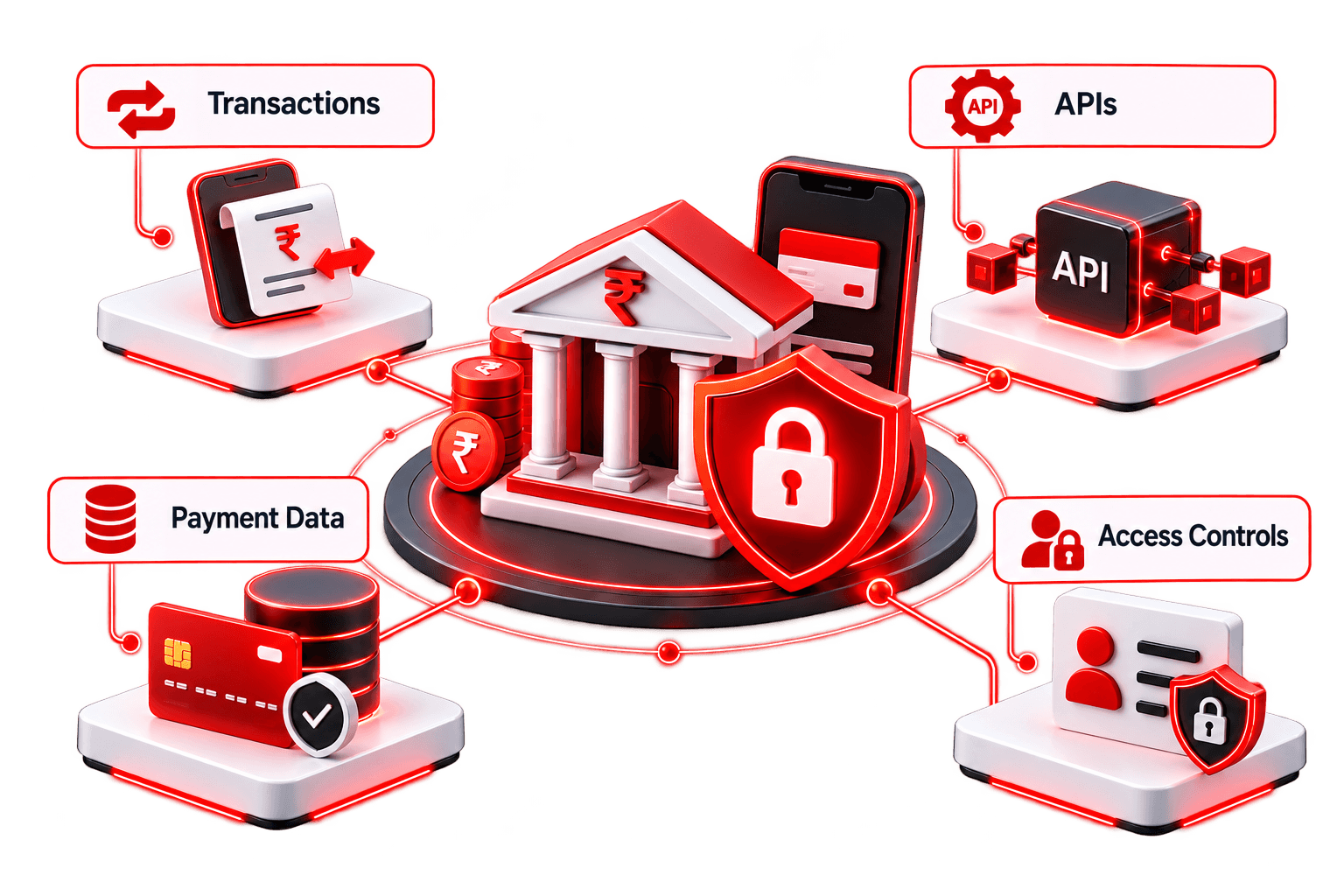
Continuous Financial Security & Compliance Standards
NuageSEC provides security testing across web applications, APIs, cloud environments, mobile applications and network infrastructure, including services relevant to banking and financial-services environments.
Why Fintech Security Requires More Than a Point-in-Time Test
Fintech platforms rarely remain static. A company may introduce a new API, change an authorization flow, launch a mobile feature, integrate a payment service, modify cloud infrastructure, or change a customer journey after the original penetration test has been completed.
That creates a practical security problem: a test can be complete while the environment continues to change.
PTaaS addresses this by making security validation part of an ongoing process rather than treating penetration testing as a single isolated event.
For regulated financial organizations, the underlying principle is also reflected in several regulatory frameworks. For example, APRA CPS 234 requires systematic testing whose nature and frequency are commensurate with changing vulnerabilities and threats, asset criticality and sensitivity, consequences of incidents, and the materiality and frequency of change.
What Does Fintech PTaaS Cover?
Web Applications
Assess customer portals, administration interfaces, account-management functions and other internet-facing applications. Evaluates authentication, authorization, session management, business logic, data exposure and application controls.
APIs & Open Banking
APIs connect mobile apps, payment systems, partner platforms and internal services. Evaluates BOLA, Broken Authentication, BFLA, and sensitive business flows per OWASP API Security Top 10 2023.
Payment & Transaction Workflows
Evaluates multi-step financial logic: transaction authorization, payment workflows, account actions, approval processes, transaction APIs, privilege boundaries, and third-party payment integrations.
Mobile Banking Applications
For fintech products delivered via Android or iOS, mobile security testing is combined with API and backend testing to evaluate security across the connected architecture rather than only the mobile interface.
Cloud & Infrastructure
Fintech systems depend on cloud infrastructure, identity controls, network configurations and supporting services. Testing extends beyond the app layer to IAM policies, serverless containers, and cloud perimeters.
External & Internal Networks
Validates internet-facing infrastructure as well as internal environments, segmentation, and SWIFT terminals. NuageSEC positions network testing for banking, transaction networks, and account environments.
Fintech Transaction & API Trust Boundary
Security testing must consider the complete business process rather than isolated endpoints. A failure at any junction compromises the financial trust boundary.
NuageSEC's API security service specifically identifies payment workflows, transaction logic, approval-process bypass and multi-step workflow testing among its business-logic testing areas.
The Fintech Security Areas That Deserve Continuous Attention
A useful fintech PTaaS program connects technical vulnerabilities directly to business functionality.
| Security Area | What the Assessment Looks At | Threat & Business Consequence |
|---|---|---|
| Authentication | Whether users, services, and systems are correctly authenticated | Credential stuffing, session hijacking, MFA bypass, and token spoofing |
| Authorization | Whether users can access only permitted accounts, objects and functions | Broken Object Level Authorization (BOLA / IDOR) and cross-customer data leakage |
| Transaction logic | Whether critical financial workflows enforce expected controls | Negative amount manipulation, race conditions, double-spending, and approval bypass |
| API security | API authentication, authorization, inventory, data exposure and business logic | Undocumented shadow endpoints, mass assignment, and unthrottled endpoint abuse |
| Sensitive data | Protection of financial, payment, customer and other sensitive information | Cardholder data leakage, unencrypted logging, and regulatory breach notifications |
| Third-party integrations | Security boundaries between the fintech platform and external services | Payment gateway tampering, webhook spoofing, and supply-chain compromise |
| Cloud security | Identity, storage, network and workload-related configuration risks | Over-privileged cloud IAM roles, exposed S3/storage buckets, and control plane leaks |
| Mobile security | Mobile application controls and communication with backend services | Insecure local storage, runtime tampering, reverse engineering, and API key theft |
| Network security | Exposed services, segmentation and infrastructure controls | Lateral movement from DMZ into core banking subnets and SWIFT terminals |
| Remediation | Whether identified weaknesses have actually been addressed and closed | Persistent unverified vulnerabilities surviving across release cycles |
OWASP emphasizes that API vulnerabilities can have direct business consequences, including unauthorized data access, data manipulation and abuse of sensitive business flows.
PTaaS for Fintech vs Traditional Penetration Testing
| Dimension | Traditional Penetration Testing | Fintech PTaaS |
|---|---|---|
| Engagement Structure | Usually organized as a defined, one-off project assessment | Supports recurring or on-demand testing aligned with release cadences |
| Environment Fit | Strong point-in-time validation for static architectures | Supports validation across rapidly changing fintech applications and APIs |
| Remediation Connection | Findings delivered as a static report for internal remediation | Testing is connected to remediation guidance and follow-up validation |
| Retesting SLA | Retesting may be handled as a separate billable activity later | Remediation validation forms an integral part of the ongoing engagement |
| Organizational Alignment | Often project-oriented and compliance-checklist driven | Better suited to high-growth organizations with continuous software delivery |
| Regulatory Cadence | Security review conducted at rigid annual calendar intervals | Security validation is aligned dynamically with risk and material change |
APRA CPS 234 explicitly ties testing frequency to changing vulnerabilities, threats and changes to information assets rather than rigid annual calendars.
How Fintech PTaaS Works — 7-Step Validation Lifecycle
PTaaS and Financial-Sector Compliance
PTaaS supports a broader security and compliance program; it should not be presented as a universal compliance solution. Requirements depend on jurisdiction and operational scope.
What Makes a Fintech PTaaS Program Effective?
A strong program should be built around five foundational principles.
Business-Contextual Testing
The assessment understands what the financial application actually does, which transactions matter, and where money or data moves.
API and Application Coverage
Testing does not stop at automated scanners. OWASP highlights authorization and sensitive business-flow risks requiring manual behavioral analysis.
Risk-Based Frequency
Testing frequency reflects the threat environment, critical assets, and rapid rate of code deployment rather than a rigid calendar interval.
Remediation Validation
A finding does not remain an open item in a PDF. Re-testing verifies whether engineering fixes properly eliminated the underlying flaw.
Evidence for Stakeholders
Engineers get technical PoCs while executives, board members, partner banks, and regulators receive clear business risk summaries and attestations.
Who Is Fintech PTaaS For?
Relevant to technology organizations operating high-consequence, rapidly evolving digital financial products.
Fintech Platforms
Digital financial products, wealth-tech apps, and neo-banking platforms with continuously changing web portals and microservices.
Payment Technology Companies
Gateways, POS software, payment orchestration providers, and merchants handling payment card data and transaction routing.
Digital Banking Platforms
Core banking systems, customer account portals, open banking APIs, and connected ledger environments.
Financial Technology SaaS Providers
Multi-tenant B2B platforms serving financial institutions, loan origination software, and compliance reporting tools.
Financial Organizations with Digital Products
Established financial institutions and credit unions expanding mobile channels, customer APIs, and digital onboarding journeys.
Fintech PTaaS Assessment Scope Checklist
What You Receive from a Fintech PTaaS Engagement
NuageSEC provides executive and technical reporting, business-context-adjusted CVSS scoring, compliance mapping, and re-testing validation.
Executive Deliverables
- Executive Summary: High-level overview of strategic security posture for C-suite, board, and partner banks.
- Risk Matrix: Business-adjusted CVSS v3/v4 scoring categorized from Critical through Informational.
- Letter of Attestation: Formal third-party attestation of testing completion for auditors and enterprise clients.
Technical Deliverables
- Technical Security Report: In-depth vulnerability descriptions, affected parameters, and impact analysis.
- Step-by-Step Proof of Concept: Reproducible exploit evidence, raw HTTP requests, and sanitized screenshots.
- Actionable Remediation Guidance: Concrete code, configuration, and architectural fix recommendations.
- Developer Ticketing Exports: Structured CSV or JSON exports ready for ingestion into Jira, GitHub, or GitLab.
Verification & Compliance
- Compliance Mapping: Relevant cross-referencing to PCI DSS, DORA, APRA CPS 234, and RBI frameworks.
- Re-Testing & Fix Verification: Free validation of remediated vulnerabilities with updated reports in 2–3 business days.
Frequently Asked Questions
What is PTaaS for fintech?
PTaaS for fintech is a penetration-testing model designed to provide recurring or on-demand security validation for changing financial technology environments, including applications, APIs, business workflows, cloud infrastructure and other defined attack surfaces.
Why do fintech companies need PTaaS?
Fintech environments can change frequently through new releases, APIs, integrations, infrastructure changes and new digital workflows. PTaaS provides a way to repeatedly validate security rather than relying only on a single historical assessment.
Does fintech PTaaS include API testing?
It can. API testing is particularly relevant to fintech environments because APIs frequently connect applications, mobile platforms, partners, payment services and internal systems. NuageSEC's API security service includes authentication, authorization, business-logic and payment-workflow testing.
Does PTaaS replace a traditional penetration test?
Not necessarily. PTaaS is a service-delivery model rather than a separate security objective. The appropriate model depends on the organization's risk, environment, testing requirements and regulatory obligations.
Can PTaaS help with PCI DSS?
Security testing can support PCI DSS-related security validation where the relevant payment-card environment and requirements apply. It does not, by itself, establish PCI DSS compliance. PCI SSC identifies PCI DSS as a baseline of technical and operational requirements for protecting payment account data.
Does PTaaS support regulatory testing requirements?
It can support security-testing programs, but applicability depends on the entity and regulation. For example, APRA CPS 234 requires systematic testing, while DORA establishes specific digital-resilience and TLPT requirements for applicable financial entities.
How often should fintech penetration testing be performed?
There is no single frequency that applies to every fintech organization. Testing should consider risk, asset criticality, threat changes, business changes, regulatory requirements and the organization's security-testing strategy. APRA CPS 234, for example, explicitly links testing frequency to these types of factors.
Can NuageSEC re-test vulnerabilities after remediation?
Yes. NuageSEC states that it performs re-testing and provides updated reporting within 2–3 business days after fixes are verified.
Explore Connected PTaaS Services & Methodologies
PTaaS Platform
Manage recurring and on-demand penetration testing through a unified vulnerability portal.
Explore PlatformContinuous Penetration Testing
Align testing cadences with release sprints and recurring changes after initial scoping.
Explore Continuous PTaaSWeb Application PTaaS
Evaluate customer portals, customer dashboards, and web banking applications.
Explore Web App PTaaSAPI PTaaS
Assess REST, GraphQL, and microservice APIs connecting payment flows and partner integrations.
Explore API PTaaSCloud PTaaS
Evaluate AWS, Azure, and Google Cloud environments supporting financial infrastructure.
Explore Cloud PTaaSRemediation & Re-Testing
Verify that identified vulnerabilities are properly closed with free re-testing validation.
Explore Re-TestingYour fintech environment keeps changing. Your security validation should keep pace. Assess applications, APIs, payment workflows and cloud infrastructure with continuous assurance.
Related Topics
Start Your PTaaS Assessment
Tell us about your organization. Our PTaaS team will get back within one business day to define the right scope and next steps.
