PTaaS Assessment & Scoping: Define the Right Penetration Testing Scope
A PTaaS assessment and scoping process establishes what should be tested, why it should be tested, how testing will be conducted, what information the testing team needs, and how findings will be handled after the assessment. NIST SP 800-115 recommends treating security-assessment planning as a structured process covering objectives, scope, requirements, roles, limitations, resources, timelines and deliverables.
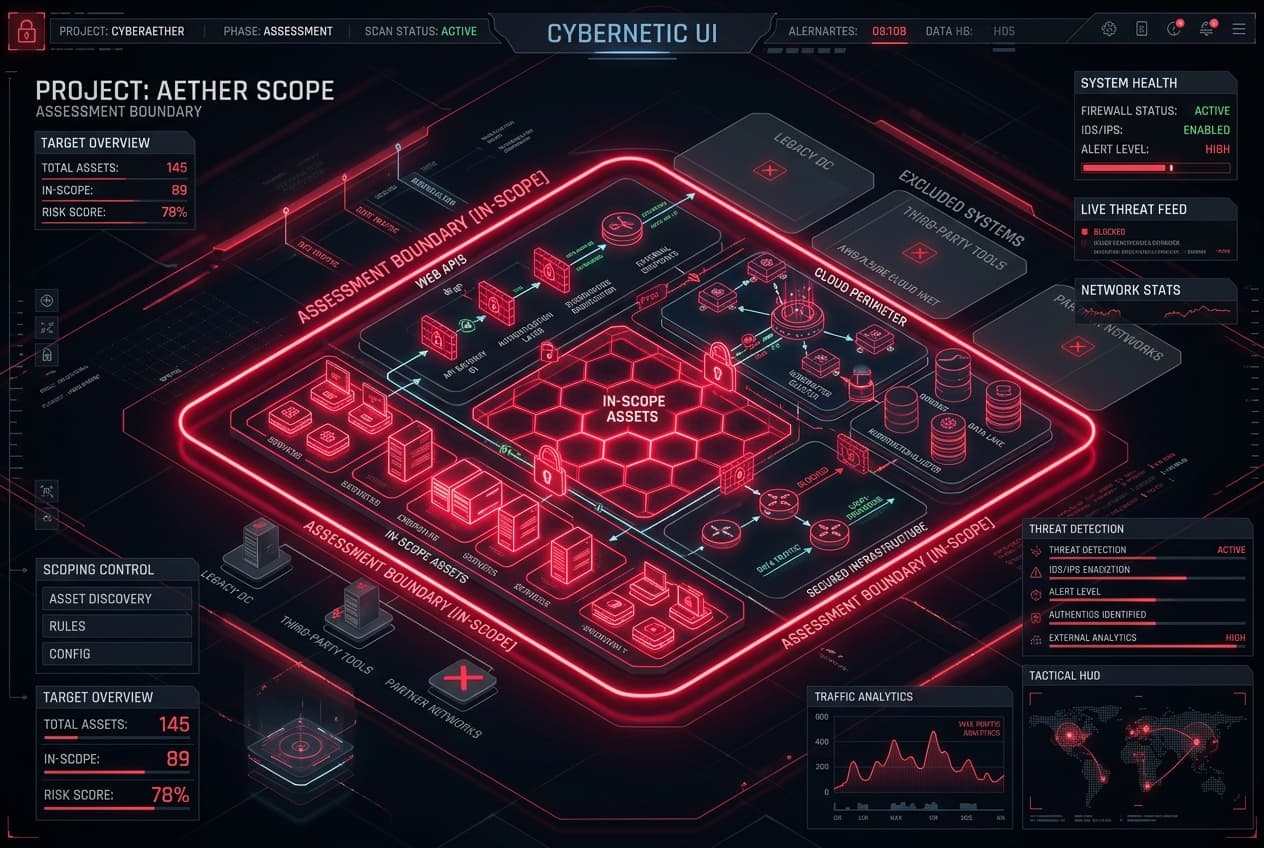
Structured Pre-Engagement Scoping Standards
A penetration test is only as useful as the scope behind it. Testing the wrong assets wastes time; unclear testing boundaries create operational risk.
What Is a PTaaS Assessment?
A PTaaS assessment is the planning and scoping stage of a penetration-testing engagement. It connects the organization's business and technical objectives with a practical testing plan.
A well-defined assessment establishes: what is being tested, why it is being tested, which assets are included, which assets are excluded, which user roles need assessment, which environments can be tested, what access is required, which business workflows matter, how testing will be conducted, what will be delivered, and how remediation and re-testing will be handled.
NIST SP 800-115 describes assessment planning as a critical component of a successful security assessment and recommends documenting the assets, threats, controls, goals, scope, responsibilities, limitations and deliverables before execution.
Why PTaaS Scoping Matters
A penetration test should answer a defined security question. The testing scope must be built directly around that objective rather than executing a generic, disconnected checklist.
Scope (What Will Be Tested)
- Identifies the actual internet-facing and internal attack surfaces.
- Enumerates specific web applications, APIs, cloud environments, and networks.
- Establishes strict boundaries and explicit exclusions to protect third-party assets.
- Prioritizes business-critical transactions, approval paths, and sensitive data stores.
- Defines which authorized user roles and privilege boundaries require validation.
Rules of Engagement (How Testing Is Conducted)
- Specifies authorized testing windows and timeframes (e.g., off-peak or business hours).
- Establishes escalation contacts, emergency procedures, and conditions for pausing testing.
- Governs sensitive-data handling, rate limits, and safe-harbor operational thresholds.
- Coordinates communication channels between security teams and lead penetration testers.
- Defines criteria for vulnerability re-testing and remediation verification.
PTES describes scope definition as one of the most important parts of a penetration test and separates scope from rules of engagement. Scope defines what will be tested; rules of engagement define how the test will be conducted. That distinction is essential to a professional PTaaS engagement.
PTaaS Assessment: What Should Be Defined Before Testing?
Eight foundational elements must be established during the pre-engagement scoping phase to ensure technical precision, production safety, and business alignment.
OWASP's current Web Security Testing Guide (WSTG) emphasizes authentication, authorization, session management, and business logic testing, noting that the framework is adaptable to an organization's threat model rather than a rigid checklist.
User Roles and Access Levels to Scope
OWASP specifically includes authorization testing to determine whether authenticated users can access resources or perform actions beyond their assigned permissions.
| User Type | Example Assessment Purpose | Testing Focus & Security Boundary |
|---|---|---|
| Unauthenticated user | Publicly accessible functionality | Login brute force, registration tampering, public API discovery, credential stuffing, information disclosure |
| Standard user | Ordinary account permissions | Horizontal privilege escalation (BOLA / IDOR), cross-account data access, session tampering, profile isolation |
| Privileged user | Elevated functionality & team manager | Vertical privilege escalation, approval workflow bypass, unauthorized data viewing, department boundary tests |
| Administrator | Administrative controls & configuration | Cross-tenant switching, credential resets, audit log tampering, global setting modification, privilege abuse |
| Support user | Internal / support diagnostic functions | Impersonation abuse, back-office data extraction, bypass of secondary authorization, customer data leaks |
| API client | Machine-to-machine authorization | OAuth token forgery, client credential tampering, scope bypass, rate-limit evasion, webhook manipulation |
| Partner / Integration user | External trust boundaries & webhooks | Cross-partner data leaks, integration credential abuse, SSRF via webhooks, unintended API exposure |
Providing at least two separate accounts for each user role allows penetration testers to thoroughly validate horizontal authorization boundaries (e.g., verifying User A cannot access or modify records belonging to User B).
PTaaS Scope by Technology
Web Application PTaaS Assessment
Define application URLs, authentication mechanisms, user roles, administrative consoles, critical workflows, and sensitive data functions. Methodologically aligned with OWASP WSTG v4.2.
API PTaaS Assessment
Define endpoints, technologies (REST, GraphQL, SOAP, gRPC), authentication, authorization tokens, sensitive data flows, and documentation. Covers BOLA, BFLA, and mass assignment.
Cloud PTaaS Assessment
Identify cloud boundaries across AWS, Azure, and Google Cloud: IAM roles, bucket storage, serverless workloads, VPC network configurations, control planes, and supporting services.
Mobile PTaaS Assessment
Define Android (APK/AAB) and iOS (IPA) binaries, application versions, local data storage encryption, reverse engineering protections, jailbreak/root detection, and backend API boundaries.
Network PTaaS Assessment
Determine internal and external networks, VPN gateways, Active Directory domains, network segmentation boundaries, wireless infrastructure, firewalls, and authorized servers.
The PTaaS Scoping Framework
A practical framework connects the organizational rationale for security testing directly to technical test execution without treating scoping as a mindless list of IP addresses.
Exclusions and Rules of Engagement (Steps 7 & 8) form the critical operational boundary protecting production availability and third-party dependencies.
PTaaS Assessment Checklist
| Your situation | Recommended starting point |
|---|---|
| Assessment objective defined | Confirmed (Risk reduction, compliance, release, or vendor assurance) |
| Applications identified | Confirmed (URLs, platforms, technologies, and code frameworks documented) |
| APIs identified | Confirmed (OpenAPI / Swagger specs, endpoints, methods, and auth tokens) |
| Infrastructure identified | Confirmed (Public IP ranges, CIDR subnets, and cloud hosting accounts) |
| User roles identified | Confirmed (Minimum 2 distinct test accounts per defined role) |
| Critical workflows identified | Confirmed (Payments, auth, data export, admin consoles, and tenant config) |
| Testing environment confirmed | Confirmed (Production, Staging, QA, or Dedicated sandbox explicit) |
| In-scope assets documented | Confirmed (Exact list of authorized targets signed off) |
| Out-of-scope assets documented | Confirmed (Third-party services, CDNs, and partners explicitly excluded) |
| Required access identified | Confirmed (Credentials, VPN profiles, and IP whitelisting arranged) |
| Third-party dependencies identified | Confirmed (Upstream vendors excluded or written authorization obtained) |
| Testing limitations documented | Confirmed (No DoS, rate limit caps, sensitive data handling thresholds) |
| Rules of engagement agreed | Confirmed (Testing windows, escalation tree, and emergency contacts set) |
| Reporting requirements defined | Confirmed (Executive summary, CVSS scoring, and POC guidelines agreed) |
| Remediation expectations defined | Confirmed (Engineering debrief, patch guidelines, and Jira export format) |
| Re-testing approach defined | Confirmed (Re-test window, scope, and verification report SLA established) |
Confirm each checkpoint before authorizing penetration testing execution to guarantee safe, thorough, and compliant testing.
How a PTaaS Assessment Works — 11-Step Lifecycle
NIST SP 800-115 describes testing as progressing through planning, execution, and analysis/mitigation activities, with pre-engagement planning establishing the foundation.
PTaaS Assessment vs Penetration Testing
| Dimension | PTaaS Assessment & Scoping | Penetration Testing Execution |
|---|---|---|
| Core Purpose | Defines objectives, boundaries, prerequisites, and rules | Executes technical security testing against authorized targets |
| Target Definition | Establishes inclusions, exclusions, and rules of engagement | Validates security weaknesses within agreed boundaries |
| Workflow Analysis | Identifies business-critical workflows, user roles, and data flows | Simulates real-world adversary exploitation across those workflows |
| Access Setup | Defines credentials, environment access, and documentation | Authenticates across multiple roles to test privilege separation |
| Deliverable Outcome | Produces agreed Scope Document and signed Rules of Engagement | Produces Technical Report, POC evidence, and remediation advice |
| Post-Testing Focus | Defines remediation timelines and re-test parameters | Conducts re-testing to verify that vulnerabilities are closed |
In simple terms: Assessment & Scoping asks 'What should we test, why and under what boundaries?' while Penetration Testing asks 'What security weaknesses exist within those agreed boundaries?' Both NIST and PTES treat planning/scoping as a distinct phase.
PTaaS Assessment vs Security Questionnaire
| Dimension | Security Questionnaire | PTaaS Assessment & Scoping |
|---|---|---|
| Core Focus | Collects written declarations about policies, controls, and practices | Defines the active, technical penetration testing engagement |
| Scope Level | Usually high-level and organization-wide (e.g., SOC 2 / vendor self-assessments) | Asset-level, code-level, and environment-focused technical precision |
| Origin & Driver | Often customer or vendor risk-management team driven | Collaborative technical planning between client and penetration testers |
| Technical Testing | Does not test systems, validate controls, or identify live flaws | Establishes exactly how technical penetration testing will be executed |
| Outcome | Provides paper evidence of governance policies | Sets technical rules of engagement, target inventories, and test plans |
A questionnaire may be part of your broader governance preparation process, but it does not substitute for technical assessment planning.
How to Choose the Right PTaaS Scope
The right scope depends on an organization's specific technical footprint, risk exposure, and compliance drivers rather than a generic one-size-fits-all package.
Common PTaaS Scoping Mistakes to Avoid
Avoid these frequent planning missteps that leave critical attack surfaces unassessed or create operational friction.
Scoping Only the Front End
A web interface depends on APIs and backend services. Testing only the web frontend while omitting underlying microservices leaves the primary data transfer layer unassessed.
Testing Only One User Role
Authorization weaknesses often require multiple roles to evaluate access boundaries properly. Testing a single role prevents verification of horizontal (BOLA) and vertical escalation.
Ignoring Business Logic
Some security weaknesses depend on how the application is supposed to work rather than simple misconfigurations. Relying solely on automated scanners misses transaction tampering.
Leaving Exclusions Unclear
Unclear boundaries risk accidental scanning of third-party SaaS vendors, CDNs, or upstream payment gateways, potentially violating third-party terms of service.
Treating Every Asset Equally
A massive list of low-impact marketing domains wastes testing budget. High-risk, business-critical workflows deserve deeper, manual-first penetration testing attention.
Not Planning Re-Testing
Finding a vulnerability is only one part of the security lifecycle. Failing to budget for remediation re-testing leaves engineering teams without independent validation that fixes hold.
What Should Be Ready Before PTaaS Begins?
What Should the Final PTaaS Deliverables Include?
All deliverables should be explicitly agreed upon during the scoping stage and delivered via encrypted portals and reports.
Executive Deliverables
- Executive Summary: A decision-oriented overview of major findings, organizational posture, and business risk for C-suite and board.
- Risk Heat Map: Visual representation of findings mapped across business impact and exploit likelihood.
- Attestation Letter: Formal third-party attestation of testing completion for customer and auditor review.
Technical Deliverables
- Technical Finding Details: Full vulnerability description, CVSS v3.1/v4.0 score, CWE mapping, and affected asset.
- Proof of Concept (PoC): Step-by-step reproduction steps, raw HTTP requests/responses, and exploit screenshots.
- Remediation Guidance: Actionable, code-level and configuration-level guidance tailored to developers.
- Jira / GitHub Export: Structured JSON or CSV export for immediate ticket ingestion into issue trackers.
Verification & Compliance
- Compliance Mapping: Relevant mapping where it forms part of the engagement (OWASP, NIST, PCI DSS, SOC 2).
- Re-Testing Report: Post-remediation verification report confirming closed vulnerabilities and residual risk.
When Should PTaaS Scope Be Reassessed?
Scope does not have to remain static forever. A new assessment scope is appropriate when significant architectural or business shifts occur.
New Application or Service Launch
Deploying a new web application, customer portal, or mobile app creates an unassessed attack surface requiring baseline scoping.
Major Application Functionality
Introducing major new workflows—such as financial transactions, document processing, or identity management—demands scoped testing.
New APIs & Webhooks
Exposing new REST, GraphQL, or gRPC endpoints expands programmatic attack surfaces and requires dedicated authorization scoping.
New Cloud Architecture
Migrating workloads, redesigning VPC networks, or deploying serverless containers alters trust boundaries and cloud IAM configurations.
Authentication & Role Refactors
Shifting to SSO, SAML, OAuth, passwordless login, or multi-tenant authorization requires targeted access boundary re-evaluation.
New Externally Exposed Assets
Acquiring new subsidiary infrastructure or deploying new public-facing services expands external attack vectors.
Frequently Asked Questions
What is PTaaS assessment and scoping?
PTaaS assessment and scoping is the planning process used to define the objectives, assets, users, environments, testing boundaries, rules of engagement, methodology and deliverables for a penetration-testing engagement.
What should a PTaaS scope include?
A PTaaS scope should identify the assessment objective, in-scope assets, exclusions, applications, APIs, infrastructure, user roles, environments, critical workflows, testing access, restrictions, deliverables and remediation/re-testing expectations.
Why is penetration-testing scope important?
Scope determines what the testing team is authorized to assess. NIST recommends documenting scope and assessment boundaries before technical testing begins.
What is the difference between scope and rules of engagement?
Scope defines what will be tested. Rules of engagement define how the testing will be performed. PTES explicitly distinguishes these two areas.
Do all PTaaS engagements need the same scope?
No. Scope should reflect the organization's technology, objectives, business-critical functions, attack surface, risk and applicable requirements.
Does a larger scope mean a better penetration test?
Not necessarily. Effective testing depends on whether the right assets, workflows and security boundaries are assessed. A larger asset count does not automatically create better risk coverage.
Should APIs be included in a web application PTaaS assessment?
Where APIs support the application and fall within the authorized testing boundary, they may be important to include. The exact scope should be based on the application's architecture and assessment objective.
Should different user roles be tested?
When authorization is relevant, different authorized user roles can be important for assessing whether access controls are correctly enforced. OWASP's testing guidance specifically addresses authorization testing across different access levels.
What information should I provide before PTaaS?
The required information depends on scope, but may include applications, API documentation, test accounts, user roles, relevant architecture details, environments, testing objectives and authorized targets.
Can the PTaaS scope change later?
Yes. Material changes to the application, infrastructure, integrations or business functionality may justify reassessing the testing scope.
Can remediation and re-testing be included?
Yes. Where included in the engagement, identified vulnerabilities can be re-tested after remediation to validate the effectiveness of the fixes.
Does a PTaaS assessment itself establish compliance?
No. A penetration-testing assessment can provide technical evidence that supports broader security or compliance activities, but it does not automatically establish compliance with a regulatory or contractual framework.
Explore Connected PTaaS Services & Methodologies
PTaaS Platform
Manage recurring and on-demand penetration testing through a unified vulnerability portal.
Explore PlatformContinuous Penetration Testing
Align testing cadences with sprints and ongoing application changes after initial scoping.
Explore Continuous PTaaSOn-Demand Penetration Testing
Trigger targeted assessments for major release milestones or new feature rollouts.
Explore On-Demand PTaaSAutomated & Human-Led Pentesting
Combine vulnerability intelligence scanners with deep manual exploitation.
Explore Hybrid MethodologyRemediation & Re-Testing
Verify that identified vulnerabilities are properly closed with re-testing validation.
Explore Re-TestingPTaaS Integrations
Push findings directly to Jira, GitHub, Slack, and your engineering workflows.
Explore IntegrationsThe strongest penetration test starts with a clear understanding of what actually matters. Define the objective, identify the attack surface, prioritize critical workflows, set clear testing rules, and plan remediation re-testing.
Related Topics
Start Your PTaaS Assessment
Tell us about your organization. Our PTaaS team will get back within one business day to define the right scope and next steps.
