Penetration Testing as a Service for Healthcare
Healthcare organizations increasingly depend on patient portals, digital-health platforms, APIs, telehealth applications, cloud infrastructure and connected systems. As these environments change, security testing cannot focus only on whether a vulnerability exists. It must also answer a more important question: Can an unauthorized user access, modify or disrupt something they should not? Healthcare PTaaS provides recurring or on-demand security testing for defined healthcare applications, APIs, infrastructure and digital systems, combined with risk-focused reporting, remediation guidance and re-testing.
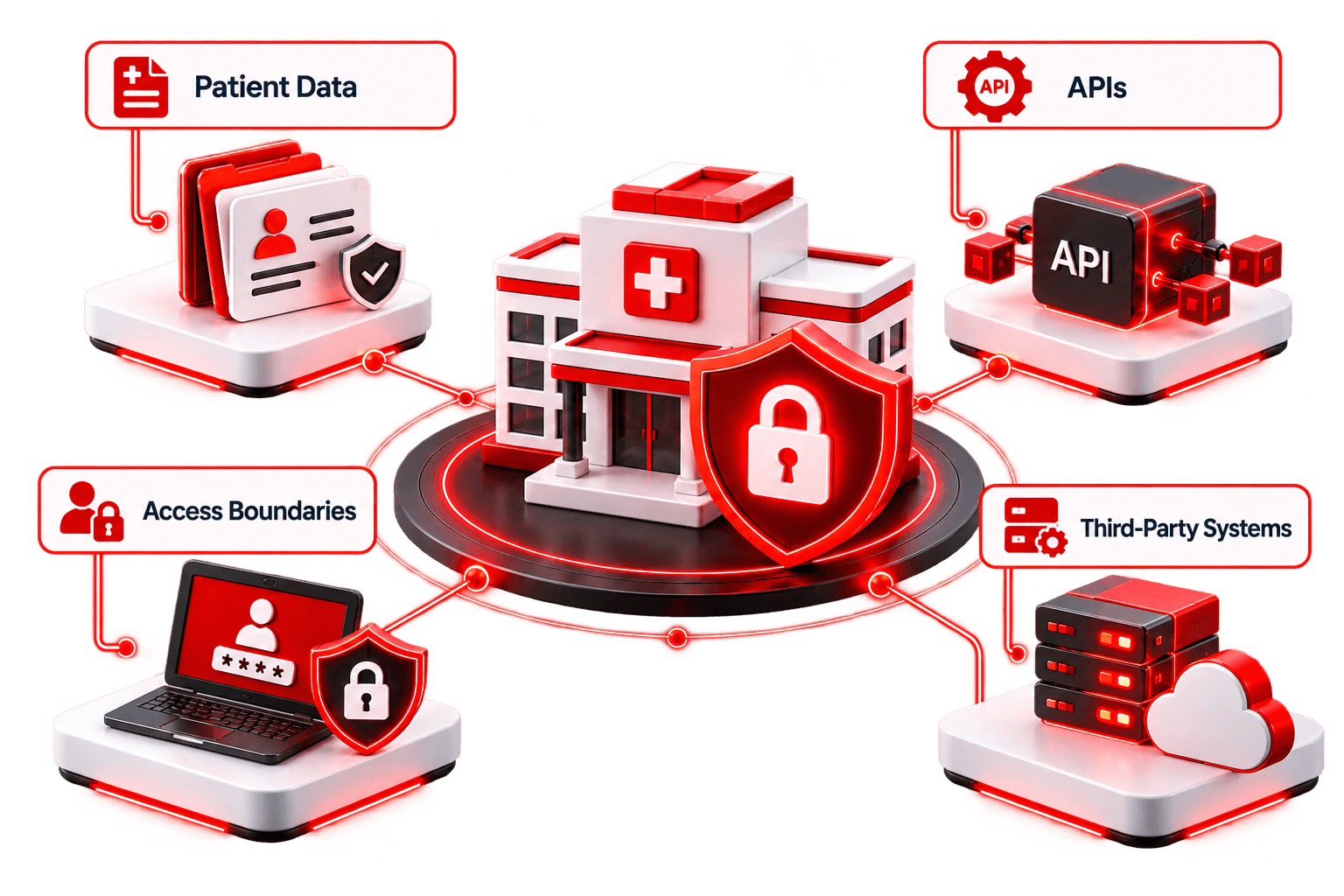
Healthcare Security, ePHI & Compliance Safeguards
NuageSEC currently positions healthcare among the industries it serves and specifically identifies electronic health records, patient portals, connected medical devices and healthcare applications as healthcare security environments.
Why Healthcare Needs a Different Approach to PTaaS
Healthcare security is not limited to protecting a database or detecting a vulnerable server. A healthcare environment encompasses an interconnected trust chain: Patient information → applications → APIs → identity systems → cloud infrastructure → third-party integrations → clinical workflows.
A weakness at any of these boundaries can create unintended access or operational risk.
The HIPAA Security Rule establishes administrative, physical and technical safeguards for electronic protected health information (ePHI), with the objective of protecting its confidentiality, integrity and availability.
For healthcare organizations, therefore, a meaningful PTaaS program should evaluate access boundaries, sensitive-data exposure, application behavior and business-critical functionality, not simply produce a list of scanner findings.
Healthcare PTaaS in Practice: First-Party Case Study
NuageSEC has a published healthcare Pentest as a Service case study involving a healthcare platform and API security assessment.
Identified Attack Vectors & Vulnerabilities
- Broken access control across patient-facing and provider endpoints.
- Insecure Direct Object References (IDOR) exposing historical patient records.
- Sensitive health data returned in API responses beyond user permission levels.
- Insufficient API user-permission validation allowing horizontal privilege escalation.
Validated Resolution & Outcome
- Collaborative debrief with healthcare engineering teams on authorization logic.
- Code-level remediation enforcing strict server-side tenant and user checks.
- Comprehensive re-testing verifying records cannot be accessed outside permissions.
- Updated security report and Letter of Attestation delivered within 2–3 business days.
The case study confirms the essential healthcare question: Is the right user accessing the right healthcare data through the right application or API?
What Does Healthcare PTaaS Cover?
Patient Portals
Patient portals provide access to personal health records, appointments, documents, and lab results. Testing evaluates authentication, authorization, session management, patient-to-patient access boundaries, and sensitive data exposure.
Healthcare APIs & FHIR
APIs connect patient apps, clinician tools, cloud services, and insurance payers. NuageSEC provides API testing across REST, GraphQL, SOAP, and gRPC to prevent BOLA, BFLA, and unintended data leaks per OWASP API Top 10.
Telehealth & Digital Health Platforms
Telehealth platforms combine web interfaces, mobile apps, video APIs, identity controls, and clinical databases. Testing ensures UI controls are strictly and independently enforced by backend services.
Healthcare SaaS Platforms
Healthcare SaaS products serve multiple hospitals, clinics, administrators, and patients from shared cloud environments. Testing validates tenant isolation and cross-organization boundary enforcement.
EHR & Clinical Applications
Applications supporting electronic health records, clinical decision support, and prescription workflows are tested for user privilege boundaries, record access logic, session timeouts, and audit logging.
Cloud Supporting Infrastructure
Healthcare applications depend on cloud infrastructure. Testing examines IAM policies, storage configurations (S3/Blob), network exposure, and container workloads across AWS, Azure, and Google Cloud.
Mobile Healthcare Applications
Mobile health apps for patients and doctors are evaluated in tandem with their backend APIs, assessing local encryption, jailbreak detection, session handling, and API communication boundaries.
The Security Boundaries Healthcare PTaaS Should Validate
Instead of treating every vulnerability as an isolated technical issue, healthcare PTaaS examines the boundaries that determine who can access what.
The objective is to verify that authenticated access does not automatically mean unrestricted access across patient boundaries.
Security Boundaries Healthcare PTaaS Must Validate
Healthcare systems require rigorous boundary testing across every interface where patient data flows.
| Boundary | Security Question Asked by Testers | Technical Exploitation Focus |
|---|---|---|
| Patient → Application | Can the patient access only their permitted functions and information? | Session validation, registration tampering, and account isolation checks |
| User → Record | Can one user access another user's healthcare information? | Insecure Direct Object References (IDOR) and record identifier tampering |
| Application → API | Does the API enforce authorization independently of the UI? | Direct API parameter manipulation bypassing client-side restrictions |
| API → Data | Can requests retrieve data outside the user's permission boundary? | Broken Object Level Authorization (BOLA) and excessive data exposure |
| User → Administration | Are privileged clinical and administrative functions restricted appropriately? | Vertical privilege escalation to provider, doctor, or system admin roles |
| Application → Integration | Does a connected service create unintended access or data exposure? | Third-party payment, lab result, and prescription gateway spoofing |
| Application → Cloud | Are supporting infrastructure controls consistent with the application security model? | Cloud storage misconfigurations and exposed database backups |
Healthcare PTaaS vs Vulnerability Scanning
| Dimension | Vulnerability Scanning | Healthcare PTaaS |
|---|---|---|
| Core Mechanism | Primarily automated scanning for known software versions and CVEs | Combines automated vulnerability analysis with expert manual security testing |
| Testing Scope | Useful for broad surface visibility and automated patch tracking | Validates security controls, clinical application behavior, and access boundaries |
| Business Logic Depth | Primarily focused on detectable technical misconfigurations | Investigates authorization logic, multi-step workflows, and IDOR flaws |
| Vulnerability Verification | Produces unverified scanner flags often containing false positives | Establishes real-world exploitability with step-by-step proofs of concept |
| Prioritization & Reporting | Generic CVSS severity scores disconnected from patient impact | Prioritized using business context and potential impact on ePHI and patient safety |
NuageSEC combines automated vulnerability identification with expert manual penetration testing to validate real-world exploitability and prioritize remediation.
What Makes Healthcare PTaaS Valuable?
Four pillars establish meaningful security assurance for healthcare platforms.
Healthcare PTaaS and HIPAA
PTaaS can support a healthcare organization's security and risk-management program, but PTaaS is not itself a HIPAA compliance certification or audit.
Current HIPAA Security Rule Reality
- Requires covered entities and business associates to implement administrative, physical, and technical safeguards for ePHI.
- HHS states that risk analysis must be accurate, thorough, and focused on potential risks and vulnerabilities to ePHI.
- The current Security Rule does not prescribe one universal annual penetration-testing schedule for every entity.
- Security measures must be reviewed and updated as needed according to organizational circumstances.
Regulatory Evolution & Proposed Rules
- HHS has proposed modifications to the Security Rule that include more specific cybersecurity requirements.
- A proposed rule should not be represented as current mandatory law.
- Healthcare PTaaS should be positioned as a testing capability that supports risk management.
- Testing frequency should be determined by environment complexity, risk profile, and change velocity.
PTaaS helps identify security weaknesses that could contribute to unauthorized access, exposure, or disruption so that healthcare organizations can remediate them before adversaries exploit them.
PTaaS for Digital Health & Connected Medical Technology
Healthcare cybersecurity increasingly extends beyond traditional web applications into connected clinical software.
The appropriate testing scope depends on device architecture, regulatory context, and authorized testing boundaries governed by documented rules of engagement.
How Healthcare PTaaS Fits Into the Security Lifecycle
What Healthcare Organizations Can Assess
The exact scope should always be established before testing and governed by documented authorization and rules of engagement.
| Environment | Example Security Focus | Primary Security Concern |
|---|---|---|
| Patient portals | Authentication, authorization, data access and session controls | Cross-patient account tampering and unauthorized document viewing |
| Telehealth platforms | Application, API, and video integration security controls | Session hijacking, recording exposure, and unauthorized stream access |
| Healthcare APIs | Authorization, authentication, and sensitive-data exposure | BOLA / IDOR exposing bulk electronic health records |
| Healthcare SaaS | Roles, tenant boundaries, APIs, and business logic | Cross-tenant data leakage between competing clinics or hospitals |
| Clinical applications | Access controls, prescription workflows, and critical functionality | Unauthorized medication changes and clinical record tampering |
| Mobile health apps | Application controls and backend/API interactions | Insecure local storage of biometric and medical history data |
| Cloud environments | Identity, storage, workloads, and network exposure | Over-privileged IAM roles and unencrypted patient database backups |
| Administrative portals | Privileged functionality and access boundaries | Administrative takeover and unauthorized staff role escalation |
| Digital-health platforms | Application, API, cloud, and integration security | Data pipeline interception and compromised third-party integrations |
| Connected technology | Relevant software, APIs, and supporting infrastructure | Remote command injection and telemetry spoofing on device backends |
What You Receive From a Healthcare PTaaS Engagement
NuageSEC's cybersecurity-services material states that its reports include an Executive Summary, detailed Technical Report, proof of concept, risk matrix, and compliance mapping, with re-testing followed by an updated report after fixes are verified.
Executive Security Summary
- Executive Overview: Clear summary of overall security posture, clinical risk, and patient data exposure.
- Risk Heat Map: Findings prioritized across exploitability and business/ePHI impact.
- Letter of Attestation: Formal third-party attestation of testing completion for auditors, payers, and partners.
Technical Security Report
- Detailed Findings: Vulnerability description, CVSS v3/v4 score, CWE category, and affected endpoints.
- Step-by-Step Proof of Concept: Reproducible reproduction steps and exploit evidence demonstrating real impact.
- Actionable Remediation Guidance: Concrete code-level and architecture recommendations for healthcare developers.
- Jira / Issue Tracking Export: Structured CSV and JSON exports for seamless engineering ticket assignment.
Verification & Compliance Mapping
- Compliance Mapping: Relevant mapping to HIPAA Security Rule technical safeguards and FDA guidance.
- Re-Testing & Verification Report: Independent verification confirming resolved vulnerabilities within 2–3 business days.
Frequently Asked Questions
What is healthcare PTaaS?
Healthcare PTaaS is a penetration-testing service model for healthcare applications, APIs, infrastructure and digital-health systems that supports recurring or on-demand security assessment, remediation and re-testing.
Is PTaaS the same as a HIPAA audit?
No. PTaaS is a technical security-testing service. HIPAA compliance involves broader administrative, physical and technical safeguards. The current HIPAA Security Rule is risk-based and does not prescribe one universal penetration-testing approach.
Does HIPAA require annual penetration testing?
The current HIPAA Security Rule does not prescribe one universal annual penetration-testing requirement. HHS has proposed modifications to the Security Rule that include more specific testing requirements, but proposed provisions should not be described as current law.
Can healthcare APIs be included in PTaaS?
Yes. APIs can be included when they fall within the authorized assessment scope. NuageSEC currently provides REST, GraphQL, SOAP and gRPC API security testing for healthcare systems.
Can patient portals be penetration tested?
Yes. Patient portals can be assessed for authentication, authorization, session management, data-access controls, business logic and other relevant security weaknesses within the approved scope.
Can telehealth platforms be tested?
Yes. Depending on architecture and authorization, testing can cover web applications, APIs, authentication, authorization and relevant integrations.
Does healthcare PTaaS protect PHI?
PTaaS does not itself protect PHI. It helps identify security weaknesses that could contribute to unauthorized access, exposure or other security risks so that organizations can remediate them.
Can medical-device companies use PTaaS?
Security testing can be performed against applicable software, APIs, cloud services and other authorized components of a connected medical technology environment. The appropriate approach depends on the product architecture and regulatory context. FDA's 2026 guidance addresses cybersecurity considerations for medical devices with cybersecurity risk.
How often should healthcare penetration testing be performed?
There is no single frequency appropriate for every healthcare organization. Frequency should consider the organization's risk, technology changes, environment and applicable requirements. HHS describes Security Rule risk analysis as an ongoing process and states that its frequency varies according to circumstances.
Does NuageSEC have healthcare PTaaS experience?
Yes. NuageSEC publicly documents a healthcare engagement categorized as Pentest as a Service, involving a web application and API security assessment and findings related to access control and sensitive-data exposure.
Explore Connected PTaaS Services & Methodologies
PTaaS Platform
Manage recurring and on-demand penetration testing through a unified vulnerability portal.
Explore PlatformContinuous Penetration Testing
Align testing cadences with clinical software releases and recurring system updates.
Explore Continuous PTaaSWeb Application PTaaS
Evaluate patient portals, telehealth interfaces, and clinician administration consoles.
Explore Web App PTaaSAPI PTaaS
Assess REST, GraphQL, and FHIR APIs connecting healthcare databases and third-party payers.
Explore API PTaaSCloud PTaaS
Evaluate HIPAA-compliant AWS, Azure, and Google Cloud environments supporting patient care.
Explore Cloud PTaaSRemediation & Re-Testing
Verify that identified vulnerabilities are properly closed with free re-testing validation.
Explore Re-TestingHealthcare technology changes. Your security validation should account for those changes. Assess defined applications, APIs, patient portals and supporting environments with continuous validation.
Related Topics
Start Your PTaaS Assessment
Tell us about your organization. Our PTaaS team will get back within one business day to define the right scope and next steps.
